In this article
What Is Albanian Flija?
This flija recipe builds a savory pie from thin ribbons of batter, cooked one round at a time and brushed with buttery cream. The ingredients are simple. The work is in the waiting: each fresh pass must set before another goes on top.
Flija (layered pancake pie), also called fli, belongs to northern Albanian and Kosovo Albanian food traditions, with variations between households. This Albanian layered pancake is usually savory rather than a sweet stack filled with jam or custard. Flour, water, salt, and dairy do most of the work.
The distinction from pastry is useful before you begin. Flija starts with a pourable batter; byrek starts with thin pastry sheets arranged around a filling, as in our byrek recipe. There is no dough to roll here.
We like the unhurried meal this dish invites. Someone pours, someone watches the browning, and nobody needs to rush straight to the table. Allow an afternoon for your first attempt, particularly while learning how quickly your oven cooks each layer.
Flija Recipe Ingredients, Equipment, and Time
The published My Albanian Food flija recipe documents a related grill method, but uses different proportions and applies dairy between successive batter passes. If choosing that alternative, follow its complete formulation and sequence rather than mixing the two methods.
This home-oven adaptation uses sour cream and melted butter between alternating batter passes. It makes one 30 cm / 12-inch pie, serving about eight alongside other food. Household versions use different combinations of cream, yogurt, and butter; this is one approach, not a single universal formula.
Allow 25 minutes for preparation, approximately two hours for cooking, and a separate 15-minute final rest. Most cooking time requires your attention, although you are not continuously pouring or brushing. Grill strength and the thickness of each pass can extend the schedule.
Batter and Dairy Mixture
For the batter:
- 500 g plain/all-purpose flour — approximately 4 US cups, spooned and leveled; weighing is more reliable.
- 700 ml water — approximately 2¾ US cups plus 3 tablespoons, with a little extra only if needed.
- 8 g fine salt — approximately 1⅓ teaspoons; salt crystal sizes vary.
For the dairy mixture:
- 500 g full-fat sour cream — approximately 2¼ US cups; weighing is preferred.
- 100 g unsalted butter, melted and cooled slightly — approximately 7 tablespoons.
For the pan:
- 10 g softened unsalted butter — approximately 2 teaspoons.
The batter should flow in a narrow, smooth ribbon, not a thick pancake mound. If necessary, add extra water a tablespoon at a time. Household recipes sometimes use yogurt; use full-fat sour cream for this version.
Choose the Right Pan
Use a shallow, heavy metal pan, about 30 cm across and 4–5 cm deep, explicitly rated for broiler or grill use. Have a small ladle, pastry brush, oven mitts, and a heatproof resting surface ready. Do not use glass under a grill or broiler.
A wider pan makes thinner layers from the same ladleful. A smaller pan makes a deeper pie, so do not substitute one without adjusting the quantity and cooking time.
How to Make Flija Step by Step
An oven grill, called a broiler in North America, supplies the overhead heat between additions in this method. Stay nearby throughout. The difference between lightly colored batter and a scorched edge can be short.
Mix the Batter and Prepare the Dairy
-
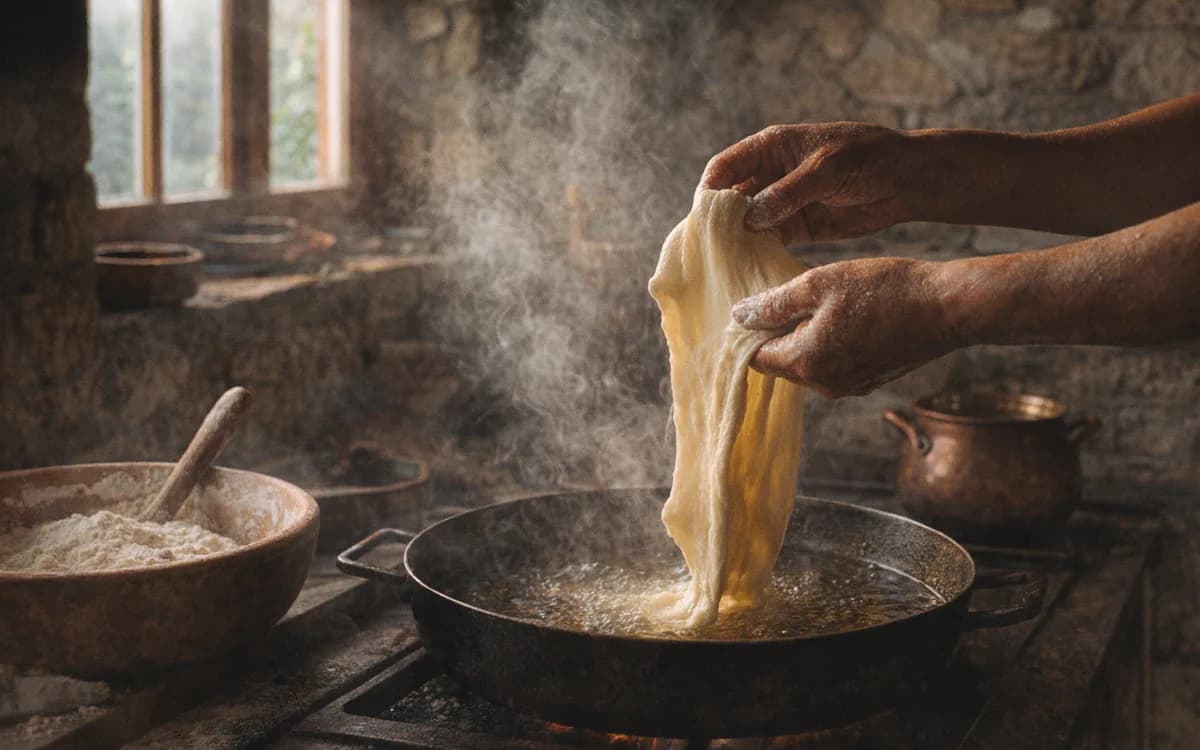
Make the batter. Put the flour and salt in a bowl. Whisk in the water gradually, starting with enough to make a smooth paste, then adding the remainder. Scrape the bottom so no pockets of flour remain. Rest for 15 minutes while preparing the dairy and equipment, then whisk again. Add water by the tablespoon only if the batter will not flow in a narrow ribbon.
-
Mix the dairy. Stir the sour cream and 100 g melted, slightly cooled butter together until spreadable. Reserve about 2 tablespoons for the top. Keep the rest beside the batter and stir occasionally if the butter begins to separate. The mixture should be warm enough to brush, not hot.
-
Prepare the heat and pan. Grease the base and sides with the 10 g softened butter. Follow your appliance's instructions for the broiler setting, preheating, rack position, and whether the door must remain open or closed. Use only a setup permitted by the manufacturer; there is no universal safe clearance for every broiler.
Pour Spokes, Cook, and Fill the Gaps
-
Cook the first batter pass. Pour thin spokes radiating from the middle toward the edge, like the marks of a wheel. Leave a narrow gap between neighboring spokes; avoid a thick puddle where they meet. Place under the grill until the wet sheen disappears and the batter begins to color, approximately 2–4 minutes per pass. Watch the batter rather than relying on the clock alone.
-
Fill the gaps and add dairy. Remove the pan to the heatproof surface. Pour fresh batter into the spaces between the cooked spokes, keeping it thin. Grill again until this new batter sets and lightly colors. These two batter passes form one complete cycle. Then brush a thin coating of dairy mixture across the cooked surface; do not brush it over wet batter.
-
Repeat the cycles. Add another spaced pattern of batter spokes, cook it, fill its gaps, and cook again. Brush with dairy after each completed two-pass cycle. Continue until the batter is used, distributing the dairy across the cycles rather than applying thick spoonfuls. For an uneven grill, rotate the pan halfway around between passes using oven mitts. If scorching begins before the batter sets, adjust the rack within the manufacturer's permitted positions.
Finish the Center and Rest Before Serving
-
Finish cooking through. Brush on the reserved dairy and briefly grill until lightly golden, watching constantly. Switch off the grill and use conventional heat at 180°C / 350°F, with the pan loosely covered in foil, for approximately 15–20 minutes. Check the center with a thin knife: it should reveal set layers, not sticky, wet batter. Extend conventional baking if needed; a browned top alone does not establish doneness.
-
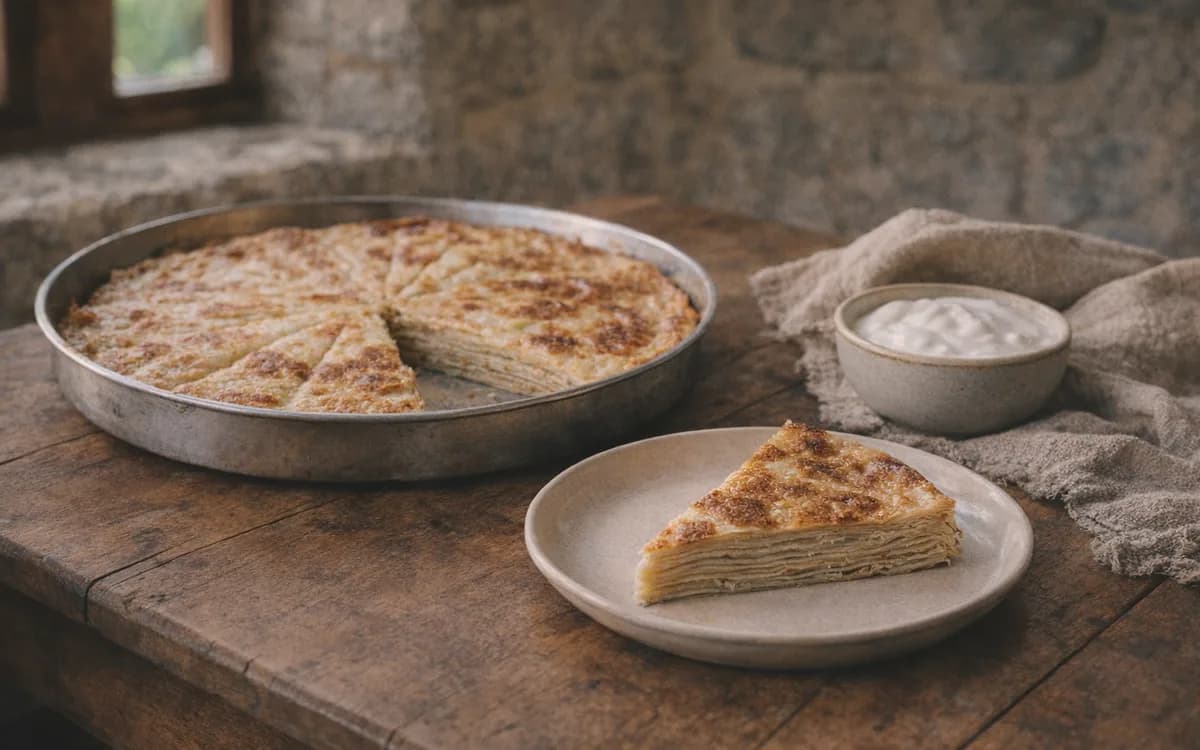
Rest and serve. Let the pie stand for a separate 15 minutes. Cut into wedges with a sharp knife and lift with a broad spatula. Serve warm rather than straight from the grill.
Flija With Saç vs. an Oven Grill or Broiler
Traditional Saç Cooking
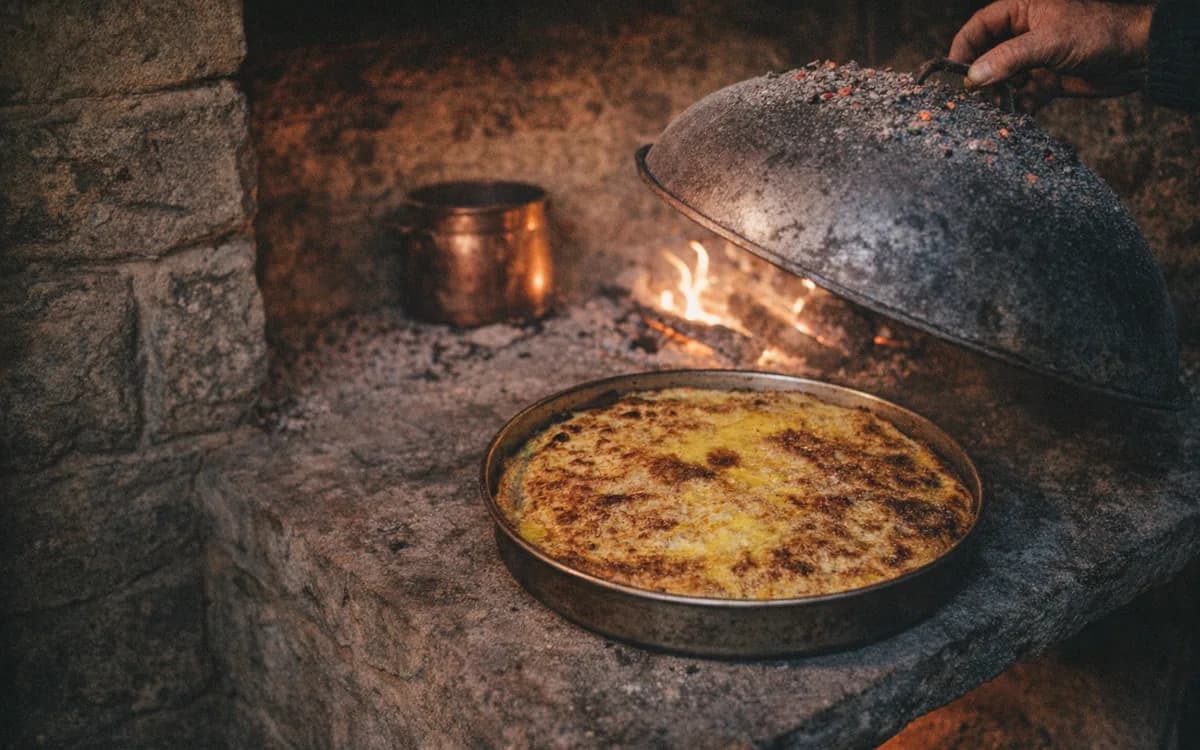
A saç (domed metal cooking lid heated with embers) supplies heat from above, while the pan also receives controlled heat from below. The lid is lifted between batter additions and replaced for the next cooking round. Managing that balance is part of the skill: fierce upper heat can brown the surface before a thick addition has cooked through.
Cooking flija with sac equipment—usually written saç in Albanian—therefore involves repeated adjustments, not simply leaving a covered pan beside a fire. The cook must manage the embers, lift a very hot lid, and keep the lower heat from burning the base during a long sequence of rounds.
The same equipment appears in other dishes, but their construction differs. Our lakror në saç article explains a pie made with pastry rather than flija's poured batter.
Treat this as cooking context, not instructions for improvising a live-fire setup. Embers and charcoal belong outdoors, hot lids require suitable lifting tools, and local fire restrictions still apply.
The Practical Home-Oven Adaptation
A UK oven grill and a North American broiler both provide overhead heat. Neither term here means an ordinary outdoor barbecue grill.
The advantage is access: you can set each thin addition before pouring the next, without tending an ember-covered lid. An electric element has its own hot spots, however, and does not reproduce the heat distribution or possible smoky notes of outdoor cooking.
A broiler is the method used here. Some adaptations bake each addition separately in a conventional oven; simply pouring all the batter into the pan and baking it once will not reproduce flija's layered construction. Seema Pankhania's flija recipe is a published example of a successive-baking method. Follow its own quantities and sequence if choosing that approach.
A lidded barbecue is also not automatically a saç replacement. Any outdoor adaptation needs equipment-specific guidance, appropriate indirect heat, and cookware approved for that use. A documented oven recipe avoids the extra variables of tending embers.
Why Flija Turns Gummy, Dry, or Uneven
Check the symptom before changing the mixture. More liquid is rarely the answer once the pie is assembled.
- Gummy center: The batter passes may have been too thick, or fresh batter may have gone over a layer that had not set. Finish under conventional heat, loosely covered, until the center is cooked. On the next attempt, use less batter per pass.
- Dry, tough layers: Long exposure under the grill or too little dairy between additions can leave the pie chewy. Shorten each pass to the time needed for setting and light color, rather than browning every addition deeply.
- Burnt top, wet middle: Overhead heat is outpacing cooking through. Adjust the pan position according to the appliance instructions, then use a covered conventional-oven finish. Do not keep grilling an already dark surface.
- Thick ridges and uneven layers: The batter may be too thick or concentrated where the spokes meet. Adjust the remaining batter with water a tablespoon at a time, then pour smaller amounts at the center.
- One side browns faster: This usually reflects the grill's heat pattern. Rotate the pan between passes, placing it on the heatproof surface first rather than turning it awkwardly beneath the element.
- Slices stick or collapse: Give the finished pie its full rest before loosening the edges and lifting a portion. For the next batch, check that the base and sides were greased evenly.
A little variation between layers is normal. Wet flour paste in the center is not; it needs further cooking, not simply a longer rest.
Serving Flija and Exploring Mountain Food in Klos
Serve flija warm in wedges or place shared portions on plates. Plain yogurt or sour cream makes a useful accompaniment, while a fresh tomato-and-cucumber salad offers contrast to the rich layers. There is no need to turn it into dessert.
For leftovers, refrigerate portions in shallow covered containers within two hours, or within one hour if temperatures exceed 32°C / 90°F. Eat within three to four days. Reheat portions thoroughly, checking that the center reaches 74°C / 165°F with a food thermometer. Covered reheating helps limit drying, although the texture is best freshly made.
Repeated cooking rounds make this a dish suited to shared preparation and a leisurely meal. At our table, we value food that gives people time to sit together. That does not mean every household makes flija the same way, or that Klos is its place of origin.
Come explore our kitchen here in Fshat, Klos, through dishes such as Byrek Bujtine (our house-style byrek) and Pule fshati me jufka (village chicken with jufka noodles). Flija is not listed on our published menu, so please do not plan a visit assuming it will be available.
Our cooking class lasts 3–4 hours and includes hands-on preparation followed by the meal you have made. The listed dishes include byrek, traditional meat dishes, and bread. Get in touch to confirm the dishes planned for your dates and group, and ask specifically whether flija preparation can be arranged.
Frequently asked questions
Are flija and fli the same dish?
Flija and fli are names used for the same layered batter dish. A fli recipe may use different dairy ingredients or cooking details, reflecting household and regional variations rather than a separate dish.
Can flija be made without a saç?
Yes. A broiler is the method used here. Some adaptations bake each addition separately in a conventional oven; simply pouring all the batter into the pan and baking it once will not reproduce flija's layered construction.
What is the difference between flija and byrek?
Flija is built from poured batter cooked in successive rounds with a dairy mixture. Byrek is made with thin pastry sheets, usually arranged around a filling; the two require different preparation methods.
Is flija vegetarian or gluten-free?
The flour-and-dairy version in this recipe is vegetarian but contains wheat gluten and milk. It is not vegan or suitable for people avoiding those ingredients, and gluten-free flour is not a direct substitution here.
Planning a food-focused stay in Klos? Book directly with us, and ask which dishes and hands-on cooking experiences are available for your dates before making plans around flija.