In this article
- What Is Tavë Kosi, and Why Is It Called Tavë Elbasani?
- Ingredients and Equipment for Albanian Lamb Yogurt Casserole
- Tave Kosi Recipe: Step-by-Step Baked Lamb with Yogurt
- How to Prevent Split Yogurt and a Watery Casserole
- What to Serve with Tavë Kosi
- Storing and Reheating Lamb and Yogurt Casserole
- Frequently asked questions
This tave kosi recipe combines tender lamb, a little rice, and a golden yogurt-and-egg custard. The meat cooks first. The topping comes later.
That two-stage method gives the shoulder time to soften without asking the delicate custard to spend hours in the oven.
We would serve it with something crisp and sharp alongside: cucumber, leafy greens, or pickled vegetables. Below is a home-oven version. Allow an unhurried afternoon, and judge the lamb by tenderness rather than the clock.
What Is Tavë Kosi, and Why Is It Called Tavë Elbasani?
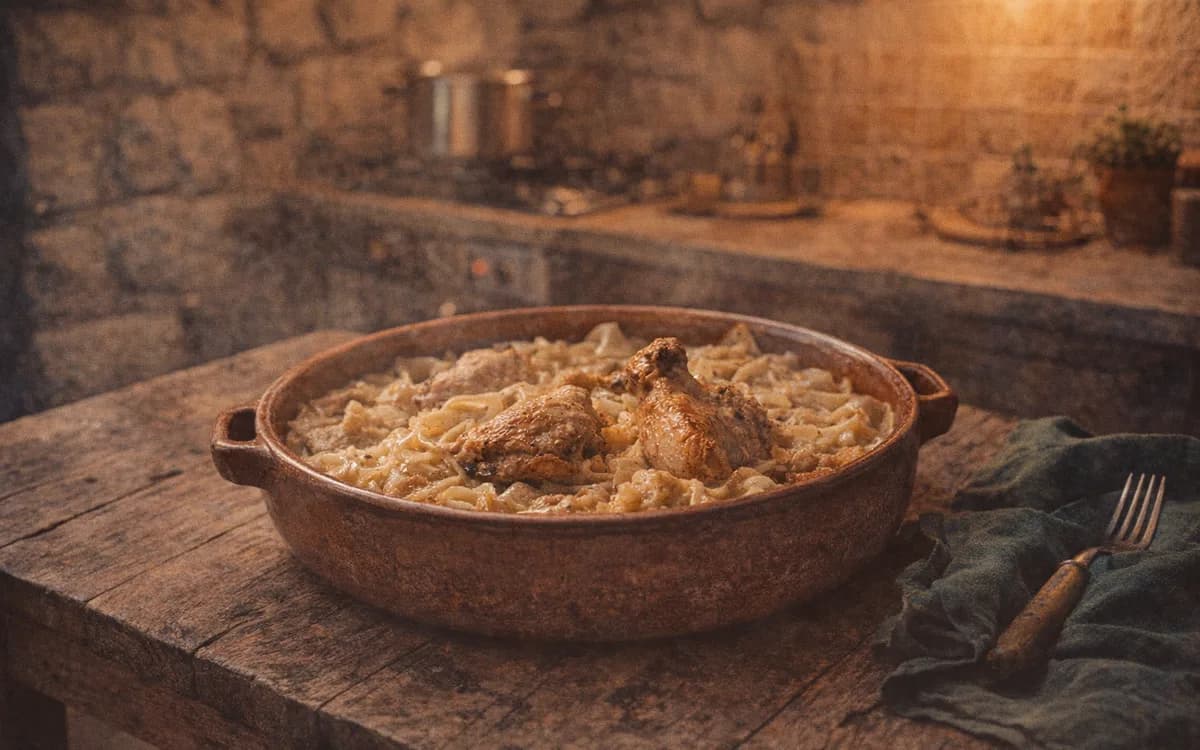
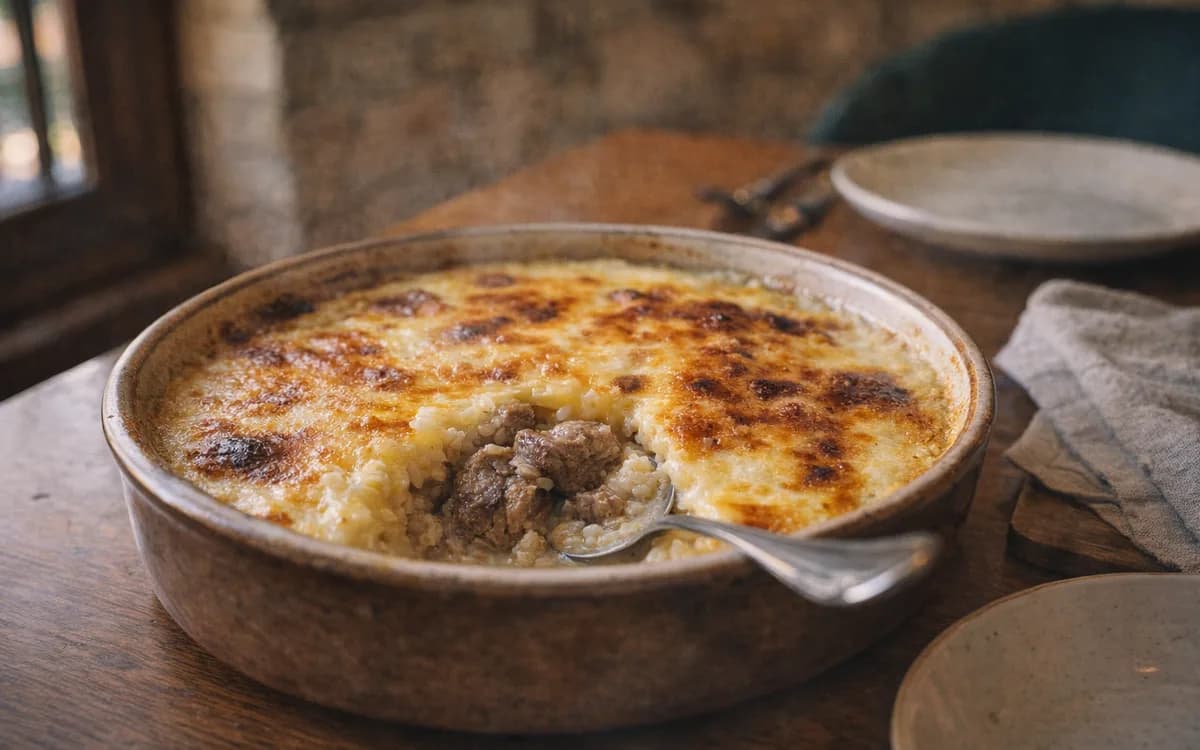
Tavë kosi (yogurt casserole) is an Albanian dish of lamb, usually a small amount of rice, and a baked yogurt-and-egg topping. The yogurt brings sourness; the eggs help it set into a soft custard around the meat. Its browned surface gives way to a tender, spoonable interior rather than a firm pie filling.
You may also hear tavë Elbasani, a name reflecting its association with Elbasan. Many people call it Albania's national dish.
Family versions differ. Some use more rice, some less; garlic and oregano appear in some preparations, while others leave the lamb and yogurt largely unadorned. Sauce-making methods vary too.
For this version, we use a small butter-and-flour sauce to carry the lamb cooking liquid into the custard. The rice is partially cooked separately. Neither should dominate: each forkful should still taste primarily of lamb and pleasantly tangy yogurt.
Ingredients and Equipment for Albanian Lamb Yogurt Casserole
Ingredients for four servings
- 800 g boneless lamb shoulder (about 1¾ lb), cut into roughly 4–5 cm chunks
- 600 g plain full-fat yogurt (about 21 oz), thick but spoonable
- 3 large eggs
- 40 g uncooked white rice (about 3 tablespoons), preferably medium-grain
- 30 g plain flour (about ¼ cup)
- 50 g butter, divided into 20 g for the lamb and 30 g for the sauce
- 300 ml water to start the lamb braise, plus extra if needed
- 200 ml reserved, defatted lamb cooking liquid, topped up with water if necessary
- 1 teaspoon fine salt, divided, then adjusted to taste before adding the raw eggs
- ½ teaspoon ground black pepper, divided
- Optional: 2 garlic cloves, crushed, and ½ teaspoon dried oregano, added to the lamb
- Water for partially cooking the rice
The braising water and the measured sauce liquid are not two additions to the finished casserole. You cook the lamb with water, then reserve just 200 ml of its liquid for the sauce.
Choosing Lamb and Yogurt
Shoulder suits slow cooking because its connective tissue softens with time. Bone-in lamb needs a different purchased weight and may take longer; do not substitute it gram for gram.
Choose unsweetened yogurt with a clean sourness. Full-fat yogurt gives a richer custard than low-fat varieties. Greek-style yogurt is an option, but heavily strained brands can make the mixture stiff; ordinary thick, spoonable yogurt is the simplest starting point.
For more Albanian dishes, explore our kitchen's menu. Ask your butcher for shoulder suited to slow cooking, and choose plain yogurt by its taste and texture.
Clay Dish or Everyday Baking Dish?
Use a covered ovenproof vessel for the lamb and a roughly 2-litre baking dish for assembly. One suitably sized dish can do both jobs.
Clay is optional. Follow its manufacturer's instructions for soaking, preheating, temperature limits, and handling; the hot-oven directions below apply to cookware approved for that use. Never put hot clay on a cold or wet surface.
Our wood-fired oven is used for breads, pies such as Byrek Bujtine (our house-style byrek), and slow dishes such as Mish qingji furre (oven-baked lamb). This home version uses the more predictable heat of a conventional oven. There is no need to recreate an open-fire setting to cook it well.
Tave Kosi Recipe: Step-by-Step Baked Lamb with Yogurt
Serves: 4. Active preparation: approximately 30 minutes. Cooking: approximately 2¼–2¾ hours. Resting: 10–15 minutes. Allow roughly 2¾–3½ hours overall, and longer if the shoulder needs it.
Lamb tenderness, dish depth, and yogurt consistency will affect the finish. Temperatures below are for a conventional oven.
Cook the Lamb Until Tender
-
Start the covered braise. Heat the oven to 160°C / 320°F, provided your cookware permits preheating. Put the lamb in the covered ovenproof vessel with 20 g butter, ¾ teaspoon salt, ¼ teaspoon pepper, and the optional garlic and oregano. Add 300 ml water. Cover tightly and cook for approximately 90–120 minutes, checking the liquid after about an hour. Add a little extra water if the bottom is becoming dry. The meat is ready when a fork enters easily and a chunk yields under gentle pressure; continue cooking if it still feels resistant.
-
Reserve the cooking liquid. Lift the tender lamb out onto a plate. Pour the liquid into a heatproof jug and spoon off the surface fat, or use a fat separator. Measure 200 ml, topping up with water if too little remains. Keep the meat and measured liquid ready while you prepare the topping.
Prepare the Rice and Yogurt Custard
-
Partially cook the rice. While the lamb finishes cooking, bring a small saucepan of water to the boil. Add the 40 g rice and simmer for approximately 5–7 minutes. The outside should soften while the centre remains distinctly firm. Drain thoroughly in a fine sieve. It will finish cooking during the final bake.
-
Make the flour sauce. Melt the remaining 30 g butter in a saucepan over medium-low heat. Stir in the 30 g flour and cook, stirring, for about 2 minutes without browning it. Gradually whisk in the measured 200 ml lamb liquid. Simmer gently for 2–3 minutes, stirring until smooth and lightly thickened. Taste and add the remaining ¼ teaspoon salt and ¼ teaspoon pepper if needed. Remove from the heat and let the sauce cool to lukewarm, stirring occasionally so it cools evenly.
-
Mix the custard. Whisk the yogurt and eggs together in a bowl until smooth. Add the lukewarm flour sauce gradually, whisking as you go. Steaming-hot sauce can begin cooking the eggs before the mixture reaches the oven. The finished custard should pour in a thick ribbon. If heavily strained yogurt leaves it too stiff, whisk in water a tablespoon at a time, only until pourable.
Assemble, Bake, and Rest
-
Fill the baking dish. Increase the oven to 180°C / 350°F for conventional cookware. Arrange the tender lamb in the roughly 2-litre dish and scatter the drained rice around it. Pour the custard evenly over and between the pieces. Leave a little headroom rather than filling to the rim. If using clay, follow its required heating sequence instead of automatically transferring it into this preheated oven.
-
Bake until safely set. Bake uncovered for approximately 35–45 minutes. Look for a golden surface and a softly set centre. Check the centre in several places with a food thermometer; this meat casserole should reach 74°C / 165°F throughout. Colour alone is not a doneness test. If the top browns early, cover it loosely with foil and continue checking the centre.
-
Rest before serving. Leave the casserole for 10–15 minutes before spooning it onto plates. The custard settles as it stands, making it easier to serve around the lamb. Expect a soft, spoonable texture. Bring the salad or pickles to the table while it rests.
How to Prevent Split Yogurt and a Watery Casserole
For this tave kosi recipe, aim for a softly set, lightly tangy topping. It need not look perfectly uniform: different yogurts release different amounts of whey, and a little moisture at the edge is not automatically a failure.
Choose full-fat yogurt and keep the oven at the stated temperature rather than turning it up to hurry dinner. The measured liquid and cooled sauce in the method help keep the topping balanced.
If the Yogurt Looks Grainy
A steaming-hot sauce can start setting the eggs in the mixing bowl. Harsh oven heat or prolonged baking can also leave the topping curdled-looking, particularly with a lean or watery yogurt.
Gradual mixing and controlled heat help prevent this. They cannot reverse curdling once it has happened. A slightly grainy appearance tells you about texture, not safety; still check that the casserole reaches 74°C / 165°F throughout.
If the Centre Is Too Wet
First distinguish liquid custard from a soft set. Check the centre temperature and allow the full resting time before judging the result. Excess stock, poorly drained rice, or an unusually deep dish can all delay setting or leave extra moisture.
Resist adding a large handful of rice to absorb a mistake. It changes the proportions and may not cook evenly.
Tough lamb is a separate problem: it needed longer in the covered first stage. Repeatedly baking the assembled casserole to soften it will overcook the topping. Make the tenderness check before adding any custard.
What to Serve with Tavë Kosi
We would keep the accompaniments simple. In tomato season, cucumber and tomato salad provides a cool contrast to the warm custard. Outside that season, lightly dressed greens work well. A little bread is useful for the last spoonful of sauce, though rice already supplies some starch.
Pickled vegetables are particularly good here. Their acidity cuts through the lamb's richness, and their crunch contrasts with the soft topping. A small bowl of turshi (pickled vegetables) gives everyone something sharp and refreshing between spoonfuls.
Serve with a spoon rather than trying to cut neat squares: the browned top is a lid, not a crust that holds a slice together. Let the custard come away with the lamb, then add the crisp salad beside it rather than underneath.
After a mountain day, this is a substantial supper on its own; it does not need another meat dish beside it. Water or a non-alcoholic drink keeps the pairing uncomplicated.
For a fuller Albanian meal, finish with a small portion of kabuni (rice dessert) with cinnamon. Keep it modest. Lamb and yogurt custard already make a generous main course, and a few spoonfuls of dessert are plenty.
Storing and Reheating Lamb and Yogurt Casserole
Refrigerate leftovers in shallow, covered containers within two hours of cooking. Refrigerate within one hour if the surrounding temperature is above 32°C / 90°F. Do not leave the whole casserole on the counter until completely cold. Keep the refrigerator at 4°C / 40°F or below and eat refrigerated portions within 3–4 days.
Reheat only what you need. Cover the portion and warm it gently until its centre reaches 74°C / 165°F, checking with a food thermometer rather than relying on steam at the edges. The custard will usually be firmer the second time; that is normal.
Freezing can compromise the yogurt texture, so refrigeration is the better choice for leftovers you will eat soon.
Safely stored cooked lamb can also be used, skipping the raw-meat braise. You will still need the measured liquid for the flour sauce, and the assembled leftover-meat casserole should reach 74°C / 165°F throughout.
Frequently asked questions
Is tavë kosi the same dish as tavë Elbasani?
Tavë Elbasani is another name for tavë kosi, reflecting its connection with Elbasan. Both describe lamb with yogurt-and-egg custard; household preparations vary.
Can Greek yogurt be used in this tave kosi recipe?
Yes, use plain full-fat Greek yogurt. If heavily strained yogurt makes the custard too thick to pour, loosen it cautiously with water.
Does the lamb need to be cooked before adding the yogurt?
Yes. Cook the lamb until fork-tender first. The final bake sets the custard rather than tenderising raw shoulder.
Is rice essential in tavë kosi?
Family versions differ. This recipe uses 40 g uncooked rice, partially cooked and thoroughly drained before assembly.
Does tavë kosi require a clay baking dish?
No. A conventional ovenproof casserole works. If using clay, follow its manufacturer's heating and handling instructions.
We also offer a cooking class with hands-on preparation of Albanian dishes. The lesson varies by season and group; ask which dishes we can prepare together.
Want to explore Albanian cooking with us in Klos? Book a stay, and tell us which dishes you would like to learn.