In this article
- Pispili Recipe at a Glance: Albanian Cornbread With Greens
- Ingredients for Pispili With Leeks and Spinach
- How to Make Pispili Step by Step
- Why Is Pispili Soggy, Gritty, or Crumbly?
- Spring Greens Variations: Spinach Pispili and Other Options
- What to Serve With Pispili and How to Store Leftovers
- Frequently asked questions
Pispili Recipe at a Glance: Albanian Cornbread With Greens
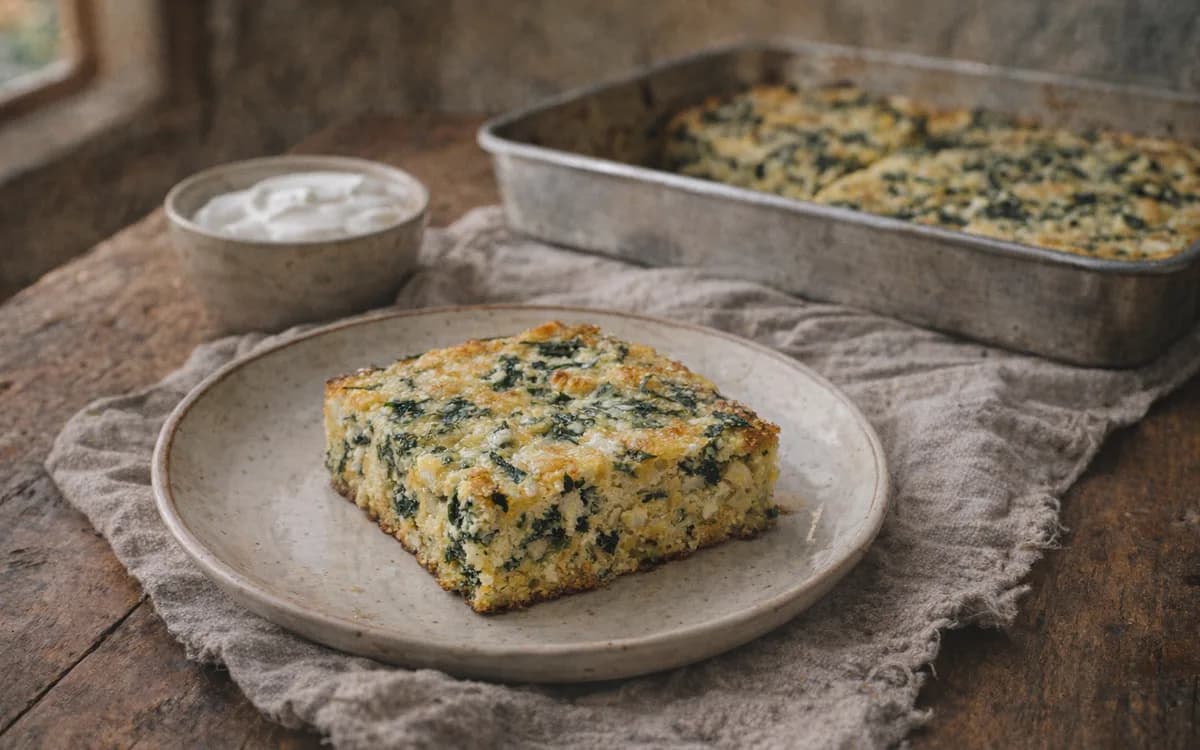
This pispili recipe brings sweet leeks, spinach, and cornmeal together in a savory bake with browned edges and a tender middle. The trick is managing the water: leafy greens should be well drained, while the cornmeal needs enough moisture to soften without becoming a wet paste.
Pispili (Albanian cornmeal bake with vegetables) comes in different household versions. Some use leeks, others leafy greens; cheese may be included, and preparations can be mixed or layered. Unlike sweet American-style cornbread, it is usually a vegetable-rich, savory dish.
We use a mixed preparation here, with crumbled white cheese distributed throughout, adapted for a home oven. Pispili is not a standing dish on our guesthouse menu.
- Yield: 6 lunch portions or 8 smaller pieces
- Preparation: About 40–45 minutes: 25 minutes hands-on, a 10-minute cornmeal soak, and 5–10 minutes for the vegetables to cool.
- Cooking: About 65–70 minutes: 20 minutes for the vegetables and 45–50 minutes in the oven; begin checking the bake at 40 minutes.
- Resting: 15 minutes after baking, before slicing
- Oven: 190°C conventional / 170°C fan
- Pan: A shallow metal baking pan, approximately 20 × 30 cm
Allow roughly 2 hours to 2 hours 10 minutes from starting to serving on this conservative schedule, including the final rest. The soak can overlap vegetable cooling, which may shorten the elapsed time; the estimate above counts those tasks separately.
Ingredients for Pispili With Leeks and Spinach
Measure the spinach after cooking and squeezing. Raw leaves and drained greens occupy very different amounts of space, so that distinction makes the batter much easier to judge.
Core ingredients
- 250 g fine or medium-fine cornmeal — weigh it rather than measuring by cups
- 400 g trimmed leeks, weighed before cooking — roughly 3 medium leeks
- 200 g cooked, thoroughly squeezed spinach — start with approximately 600 g fresh spinach or 400 g frozen spinach, then weigh after draining
- 150 g brined white cheese, drained and crumbled — about 1 cup loosely crumbled
- 60 ml olive oil — 4 tablespoons, divided: 30 ml for the leeks, 15 ml for the pan, and 15 ml for the mixture
- 350 ml warm water, with extra added in 15 ml increments if needed for a thick, spreadable mixture
- ¼ teaspoon fine salt, or omit if the cheese is particularly salty
- ¼ teaspoon ground black pepper
Which cornmeal gives the best texture?
Use ground maize, not white cornstarch. In some countries, both are sold under names resembling “corn flour”; check the ingredient label and look for finely ground maize intended for cooking or baking.
Fine or medium-fine meal absorbs water more readily than coarse polenta. Coarse meal can leave gritty particles even when the outside looks cooked. Instant polenta behaves differently too, so we would not swap it directly into these measurements.
After hydration, look for a thick, soft porridge. The finished mixture should spread with a spoon rather than pour like pancake batter.
Choosing cheese and balancing the salt
A feta-style brined white cheese works well. Gjizë (a fresh curd cheese) can be milder and wetter, so it changes the mixture. Our Albanian cheese guide explains those differences.
Taste the cheese before adding salt. Vegetarian readers should also check for vegetarian or microbial rennet rather than assuming every white cheese is suitable.
How to Make Pispili Step by Step
The vegetables go into the batter cooked, drained, and no longer steaming. Mix everything together; this preparation has no separate cornmeal crust.
Wash, soften, and drain the vegetables
-
Prepare the oven and pan. Heat the oven to 190°C conventional or 170°C fan. Coat the base and sides of a shallow 20 × 30 cm metal pan with 15 ml olive oil. Put an oven rack near the middle.
-
Clean and cook the leeks. Split the trimmed leeks lengthways and rinse between the layers, where grit often hides. Slice thinly. Heat 30 ml olive oil in a wide frying pan over medium-low heat, add the leeks, and cook for 12–15 minutes, stirring occasionally. They should soften without becoming deeply browned. If liquid collects, cook uncovered until it evaporates. Set aside until no longer steaming, allowing roughly 5–10 minutes for cooling; a deep pile may take longer.
-
Prepare the spinach. For fresh spinach, wash the leaves and wilt them in a covered saucepan with the water clinging to them, working in batches if necessary. Allow roughly 5 minutes, or longer for several batches. Let them cool enough to handle, then squeeze firmly and chop. For frozen spinach, thaw completely, squeeze, and chop if needed. Measure 200 g of prepared spinach; reserve any extra for another meal. There should be no water running from it when squeezed again.
Hydrate the cornmeal and assemble the bake
-
Hydrate the cornmeal. Stir 250 g cornmeal with an initial 350 ml warm water in a large bowl. Leave for 10 minutes so the grains can absorb the liquid. Look for a thick but soft mixture without pockets of dry meal. Different grinds absorb water differently.
-
Mix and spread. Fold in the cooled leeks, 200 g prepared spinach, 150 g crumbled cheese, the remaining 15 ml olive oil, salt, and pepper. Break up clumps of spinach so each slice gets some greens. The mixture should fall heavily from a spoon and spread under light pressure. If it is stiff and breaks apart, add water in 15 ml increments, mixing and checking after each addition. Stop when it is thick and spreadable, before it becomes pourable; the consistency matters more than a fixed extra-water limit. Transfer to the pan and smooth to an even depth, reaching the corners.
Bake, check the center, and rest before slicing
-
Bake until set. Allow about 45–50 minutes, beginning your checks at 40 minutes. Look for browned edges, a lightly colored surface, and a center that no longer wobbles. A knife inserted into the middle may carry moist vegetable crumbs, but should not emerge coated in wet cornmeal paste. If needed, continue in 5-minute intervals. If the top colors too quickly, cover it loosely with foil while the center finishes.
-
Rest and portion. Leave the pispili in its pan for 15 minutes before cutting into 6 lunch portions or 8 smaller pieces. The center firms as it cools. Lift slices with a broad spatula rather than trying to pull them out by their edges.
Aim for a tender, compact interior. Do not keep baking until the knife is completely dry: spinach and cheese will retain moisture even when the cornmeal is cooked.
Why Is Pispili Soggy, Gritty, or Crumbly?
When making this pispili recipe, check the bake after its resting period. A hot slice can seem fragile even when nothing has gone wrong.
-
Soggy center: A moist interior is normal; shiny, loose cornmeal paste is not. Wet spinach, liquid left in the leek pan, too much added water, or a smaller, deeper baking dish can all cause trouble. If the center is still underbaked, return the pan to the oven and check at 5-minute intervals. Next time, weigh the spinach after squeezing and use the specified shallow pan.
-
Gritty mouthfuls: The meal may be too coarse or insufficiently hydrated. Extra oven time alone can dry the edges without softening the grains enough. Choose fine or medium-fine cornmeal and give it the 10-minute hydration rest before adding the vegetables, checking that no dry pockets remain.
-
Dry, crumbly slices: The batter may have been too stiff, or the bake may have stayed in the oven too long. Before baking, it should spread easily with a spoon. Adjust with water in small, measured increments as described above. After baking, allow the full resting time and use a spatula to support each piece.
-
Pale or soft base: Glass and ceramic dishes generally heat differently from thin metal pans, and excess vegetable moisture can prevent browning. Use the suggested metal pan and avoid crowding the mixture into a smaller dish. A browned base is welcome, but not every oven produces the same crust.
Change one thing at a time on your next bake. Switching the cornmeal, dish, and water quantity together makes it difficult to see which adjustment helped.
Spring Greens Variations: Spinach Pispili and Other Options
Spinach pispili is a useful starting point because the leaves soften quickly and their moisture can be squeezed out. Spring is the inspiration, not a restriction: frozen spinach works throughout the year when prepared to the same 200 g cooked, drained weight.
For chard, separate the stems from the leaves and chop the stems finely. Cook the stems until tender before adding the leaves, then cool, drain, squeeze, and weigh 200 g of prepared greens. Leeks bring sweetness and soft strands rather than squeezed leaves' compact texture; for an all-leek pispili, use a recipe developed around leeks rather than replacing the spinach gram for gram.
If you enjoy nettles, our spring nettle byrek offers another greens-filled bake, this time with pastry rather than cornmeal. Use positively identified, food-grade nettles, wear gloves when handling them raw, and cook them thoroughly; unfamiliar wild plants are not a casual substitute.
You can add a tablespoon of chopped dill or parsley for a different aroma. Leaving out the cheese changes salt, fat, and texture, so a cheese-free version needs its own adjustments.
What to Serve With Pispili and How to Store Leftovers
A simple lunch plate
We would put a warm slice beside plain yogurt and a cucumber-and-tomato salad. There is no need for a heavy accompaniment. For a garlicky alternative to plain yogurt, try Xaxiq (yogurt, cucumber, and garlic dip).
Warm cornmeal, cool yogurt, then the snap of cucumber: each bite gets a fresh start.
For a vegetable-led meal in our kitchen, ask what is in season when planning your visit—perhaps Fërgesë (peppers, tomatoes, and cottage cheese) or a slice of Byrek Bujtine (our house-style byrek).
Keeping and reheating the remaining slices
Refrigeration: Serve warm, or let portions cool for serving at room temperature. Divide leftovers into shallow containers for rapid cooling and refrigerate within two hours of cooking; do not leave the pan on the lunch table all afternoon. Keep refrigerated at 4°C or below, and refrigerate within one hour if the surrounding temperature exceeds 32°C. Use refrigerated portions within three to four days.
Freezing: Once cooled, wrap individual portions and place them in a freezer container. For best quality, aim to use them within one to two months. Label the date and thaw in the refrigerator.
Reheating: An oven at 180°C conventional or 160°C fan gives the edges a chance to firm again. Cover initially if the slices look dry, then uncover briefly. A microwave is convenient but produces a softer result. In either case, reheat thoroughly to 74°C at the center and check with a food thermometer. Crispness is a texture cue, not a food-safety test.
Frequently asked questions
Is pispili the same as byrek?
No. Pispili uses a cornmeal base, while byrek uses thin pastry layers. Both can contain vegetables and cheese, but their structure and texture differ.
Can I use frozen spinach in this pispili recipe?
Yes. Thaw it completely, squeeze thoroughly, and measure 200 g of prepared spinach for this recipe. The drained weight determines what goes into the bowl.
Is pispili gluten-free?
This version contains no wheat flour, but use gluten-free cornmeal and other ingredients and avoid cross-contact if cooking for someone with coeliac disease. Other pispili recipes may include wheat flour.
Is pispili suitable for vegetarians?
This meat-free version is suitable when the cheese uses vegetarian rennet. It contains dairy, so it is not vegan; other household versions may also contain eggs.
Planning a stay in Klos and interested in vegetable-led Albanian meals? Book directly with us and tell us what you enjoy—we’ll help you plan around what is in season.