In this article
What is Albanian chicken rice?
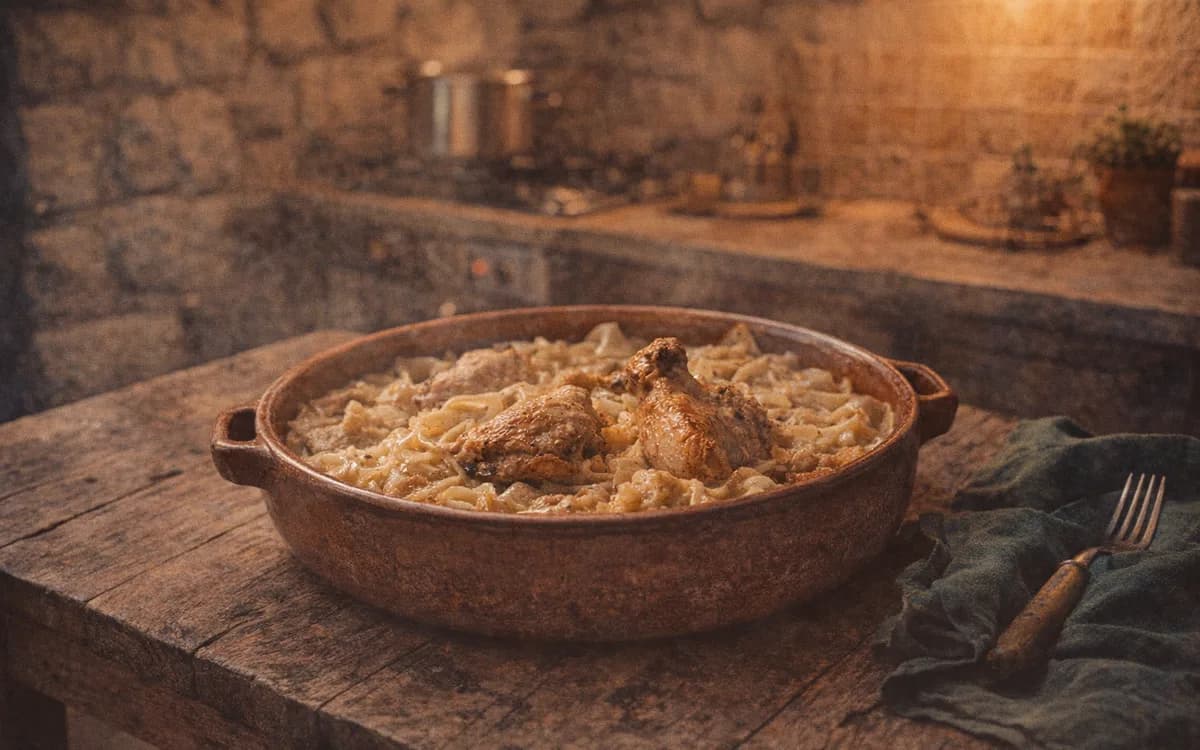
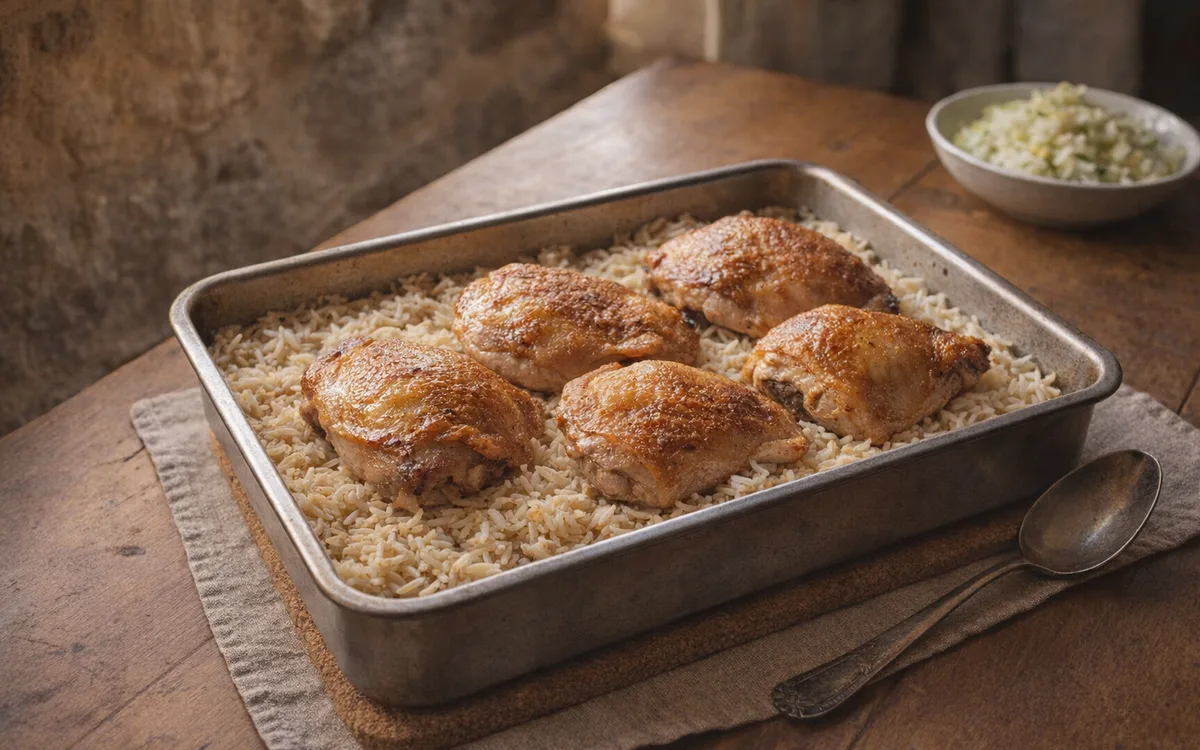
Albanian chicken rice brings golden chicken and stock-soaked grains to the table in one baking tray. Called pulë me oriz (chicken with rice), it makes a generous family supper without needing much alongside. For this home-oven version, we use bone-in thighs, ordinary white long-grain rice and a measured amount of hot stock.
The rice goes into the oven uncooked. It absorbs the stock and chicken juices beneath a tight foil cover, then finishes uncovered so the surface loses its excess moisture.
You may also hear Albanian chicken pilaf used for related preparations. Household methods differ: some cooks simmer the chicken first, while others brown it. There is no single seasoning mixture shared by every family. Tavë me pulë means a chicken bake; the name alone does not tell you whether it contains rice.
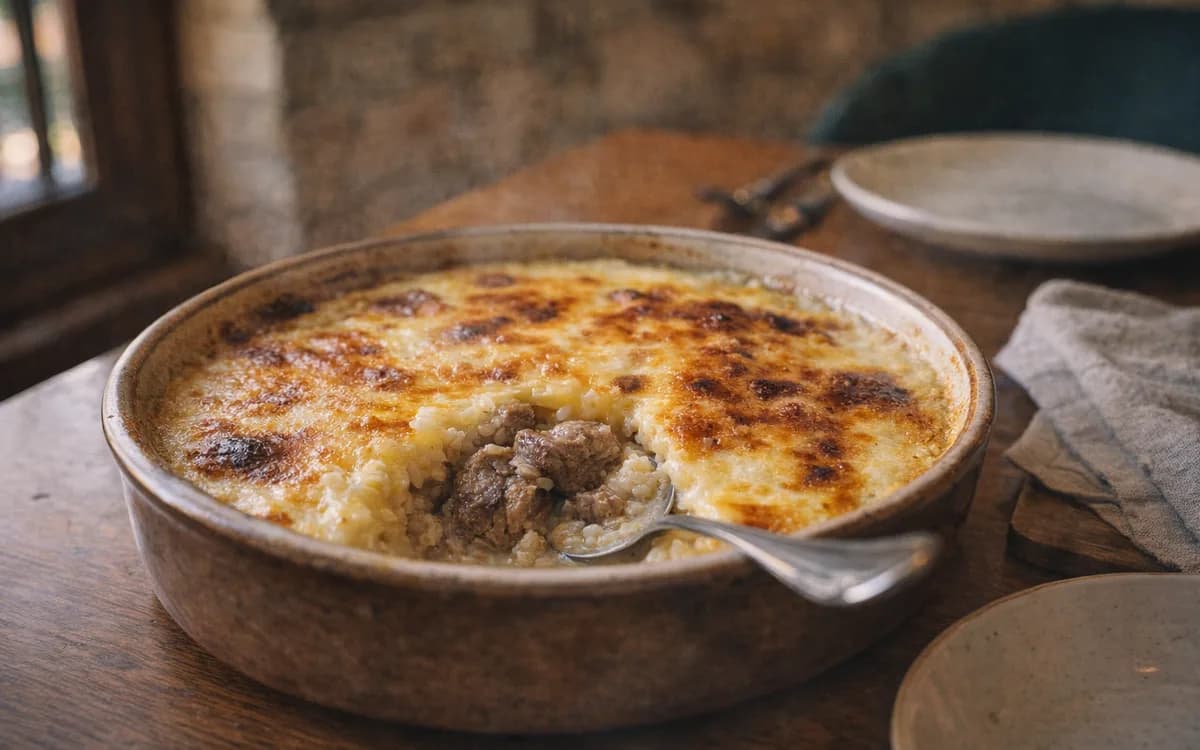
This is different from chicken with jufka, which uses egg noodles. It is also separate from tavë kosi, whose defining feature is a yogurt-and-egg custard. Here, the grains stay distinct, with no custard binding them.
Ingredients, rice variety and the right baking tray
Serves four generously. Allow about 15 minutes for preparation, 60–70 minutes for cooking and 10 minutes for resting: roughly 85–95 minutes altogether. Chicken size and the rice's progress determine the finishing time.
What you need
- 4 bone-in, skin-on chicken thighs, approximately 1–1.2 kg total
- 350 g ordinary white long-grain rice, not easy-cook or parboiled
- 700 ml hot low-salt chicken stock
- 1 medium onion, approximately 150 g, finely chopped
- 25 g butter
- 15 ml olive oil
- Salt, adjusted to the saltiness of the stock
- Ground black pepper, to taste
- Chopped parsley and lemon wedges, optional, for serving
- Extra boiling chicken stock, only if needed, added in 50 ml portions
Use a metal baking tray measuring approximately 23 × 33 cm internally and at least 5 cm deep. You will also need foil, a frying pan, a sieve and a food thermometer. A tray that can stand securely on a baking sheet is easier to handle when filled with hot stock.
Why ordinary white long-grain rice is the baseline
We want tender grains that separate under a fork, not a creamy risotto texture. Rinse the rice briefly under cold running water, then drain it thoroughly in a sieve. Do not soak it: the liquid allowance assumes rinsed, well-drained, unsoaked rice.
Brown, short-grain, parboiled and easy-cook rice behave differently. They are not direct substitutions with this stock quantity and cooking schedule. Even ordinary long-grain brands vary slightly, so taste a few grains before deciding the tray is ready.
Why the pan size matters
The rice needs an even layer, with the thighs spaced across it. A much wider tray exposes more liquid to evaporation; a smaller, deeper dish crowds the chicken and changes how the rice cooks. A tightly crimped foil cover matters just as much as the starting stock measurement.
How to make pulë me oriz in the oven
Brown the chicken and build the rice base
-
Prepare the oven and chicken. Heat the oven to 190°C conventional or 170°C fan, with a rack in the middle. Rinse and thoroughly drain the 350 g rice. Pat the chicken dry with kitchen paper; do not wash raw poultry. Season the thighs with black pepper and a little salt, remembering that the stock will also season the rice. Keep raw-chicken utensils away from anything intended for serving.
-
Brown the thighs. Heat the 15 ml olive oil in a frying pan over medium-high heat. Add the chicken skin-side down, working in batches if necessary rather than crowding the pan. Brown for approximately 6–8 minutes, until the skin has taken on colour and releases readily, then turn and cook the other side for about 2 minutes. Transfer to a plate reserved for the partly cooked chicken. Browning flavours the dish; it does not cook the meat through.
-
Soften the onion and coat the rice. Leave approximately 15 ml of rendered fat in the pan, pouring off any excess carefully. Add the 25 g butter and chopped onion. Cook over medium heat for 6–8 minutes, stirring, until softened without scorching. Stir in the drained rice for 1–2 minutes. Pour in about 200 ml of the measured hot stock and scrape the browned juices from the bottom of the pan. Those juices should go into the tray, not down the sink.
Bake covered, then finish uncovered
-
Fill and cover the tray. Transfer the rice, onion and pan liquid to the metal baking tray. Add the remaining 500 ml stock, making 700 ml in total, and spread the rice evenly. Nestle the thighs across the rice, skin facing upward. Keep the skin above the liquid rather than submerging it. Cover tightly with foil, crimping around the edges to retain steam, and put the tray in the oven.
-
Bake and assess. Bake covered for approximately 30 minutes. Lift the foil away from your face and hands: the escaping steam will be hot. Check the rice and the temperature of the chicken. If the rice has absorbed most of the liquid and is nearly tender, continue uncovered for approximately 10–20 minutes. If it is still distinctly hard and the tray is dry, follow the measured-stock correction below rather than letting it bake dry.
Check doneness and rest before serving
-
Check both components. The rice should be tender without a chalky centre, with no large pool of stock remaining. Probe each thigh in its thickest part without touching bone: chicken must reach at least 75°C. If the chicken finishes first, transfer it to a clean plate and finish the rice covered, adding 50 ml boiling stock if dry. If the rice finishes first, remove the chicken to another ovenproof dish and continue cooking it until safe.
-
Rest, then serve. Once both components are cooked, rest for 10 minutes, loosely covered. Gently loosen the rice around the chicken with a fork; repeated stirring can break the grains. Add parsley and lemon wedges if you like. Bring the tray to the table on a heatproof mat, with a serving spoon for the rice and tongs for the thighs.
Fixing dry, crunchy or overly wet rice
Check several grains from around the tray, not just one at the edge. Rice that looks dry on top can still have liquid underneath; slide a spoon into a corner before adding more stock.
- Crunchy rice and a dry tray: Pour 50 ml boiling stock around the rice, reseal tightly with foil and bake for another 5–10 minutes. Taste again. Repeat only if needed, keeping any fully cooked chicken on a clean plate while the rice finishes.
- Firm rice with stock still visible: Replace the foil and give it another 5–10 minutes before checking. It needs more time to absorb the liquid, not another pour of stock.
- Tender rice with excess liquid: Remove fully cooked chicken if necessary and return the rice to the oven uncovered for about 5 minutes. Check frequently so the edges do not become hard while the centre dries.
- Mushy rice: Further baking will not make the grains firm again. Next time, check the rice variety, drain it thoroughly and measure the stock carefully. Avoid stirring during baking.
- Cooked chicken with pale skin: A brief grill finish can add colour, but only use a grill-safe metal tray. Watch continuously and shield exposed rice from scorching. Remove any foil cover before grilling.
Colour is a preference; the thermometer reading is the safety check. Different ovens and rice brands may need small adjustments, but changing the tray substantially can require more than an extra splash of stock.
What to serve with this chicken and rice bake
A sharp, fresh side suits the rich rice. We would choose finely shredded cabbage dressed with lemon and olive oil, a seasonal green salad, or a small bowl of pickled vegetables. Plain yogurt works well alongside, spooned onto the plate rather than stirred into the baking tray.
Keep it simple. The chicken and rice already make a substantial supper, and one crisp salad gives each mouthful a welcome contrast. Put the salad out while the tray rests so everyone can sit down together.
At our kitchen, Albanian cooking includes Pule fshati me jufka (village chicken with jufka noodles) and Byrek Bujtine (our house-style byrek). What carries across is the pleasure of a shared table: a generous main dish, something fresh beside it and time to eat together.
How to cool, store and reheat chicken rice safely
Cooked rice needs prompt cooling. Do not leave the whole tray on the counter until it is completely cold: a deep mass of rice holds heat for too long.
Divide leftovers into shallow containers, cool quickly and refrigerate within one hour where possible. Keep the refrigerator at 5°C or below. Use refrigerated chicken rice within 24 hours, and reheat it only once. These are deliberately conservative, rice-specific limits.
Reheat only the portion you need. Add a small splash of water or stock, cover and heat until steaming throughout, reaching at least 75°C in both the chicken and the centre of the rice. Check more than one spot, especially when using a microwave, where heating can be uneven.
Reheating does not make badly stored rice safe. If the dish has been left warm for too long, do not rely on its smell or a hotter oven to rescue it.
For freezing, cool promptly, divide into portions and freeze rather than keeping the leftovers in the refrigerator for several days first. Thaw in the refrigerator before reheating, then heat thoroughly and eat straight away.
Frequently asked questions
Does the rice need to be cooked before baking pulë me oriz?
No. Use rinsed, well-drained, uncooked white long-grain rice. It cooks in the measured hot stock beneath the chicken; pre-cooked rice would need a different method and much less liquid.
Can boneless chicken replace bone-in thighs?
Boneless chicken cooks faster, so it is not a direct swap for the full baking schedule. Its centre must reach 75°C, but leaving it in throughout the rice's cooking time may dry it out. Bone-in thighs are the baseline here.
Can brown rice use the same stock quantity and baking time?
No. Brown rice needs a different liquid allowance and a longer cooking time. These measurements apply to ordinary white long-grain rice, not brown, easy-cook or parboiled varieties.
Is Albanian chicken rice the same as tavë kosi?
No. This bake cooks rice in stock and chicken juices. Tavë kosi is a separate dish characterised by a yogurt-and-egg custard, rather than a tray of distinct, stock-flavoured grains.
Want to cook with us in Klos? Our Traditional Cooking Class lasts 3–4 hours and ends with the meal you have made. Explore our cooking class and ask which dishes are planned when you book your stay.