In this article
What Is Shqeto? The Albanian Lamb Soup Associated With Përmet
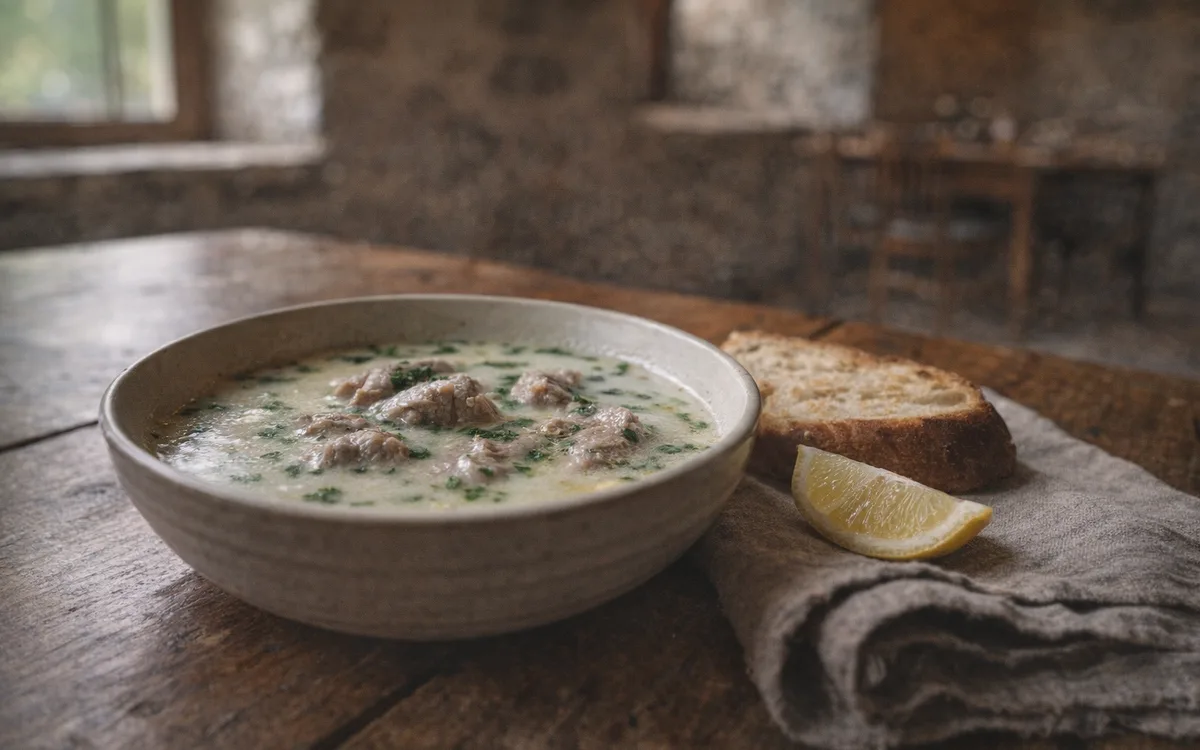
This shqeto recipe brings tender lamb, milk, egg yolks and lemon together in a pale, lightly thickened broth. Shqeto is an Albanian meat soup associated with Përmet, in southern Albania; this milk-and-egg preparation finishes with parsley and enough lemon to brighten the lamb without overwhelming it.
We are in Klos, in the Mat region, so we introduce this as a regional dish from elsewhere in Albania, not a local invention of our kitchen. Household preparations differ. Some use lamb, others kid, and the dairy and thickening methods vary too. Flour belongs to the particular preparation below, rather than being a rule for every pot of shqeto.
The result should pour easily from a ladle. Think tender pieces of meat surrounded by a savory, milky broth, not a thick cream soup or an egg custard. The lemon comes through at the end, after the lamb.
If you know Albanian paçe, keep the two dishes separate: paçe commonly draws on head meat, trotters or other collagen-rich parts. Here, shoulder or neck provides the meat and broth, while milk and yolks give the soup its gentle richness.
Shqeto Recipe Ingredients and Quantities
Serves: 4 as a main-course soup
Preparation: 20 minutes
Cooking: approximately 120–150 minutes, allowing longer if the lamb needs it
Total: approximately 2 hours 20 minutes–2 hours 50 minutes
You will need a heavy saucepan or casserole, a sieve, a measuring jug, two bowls, a whisk and a food thermometer.
Ingredients
- 800 g bone-in lamb shoulder or neck, cut into roughly 5–7 cm pieces suitable for simmering
- 1.5 litres cold water, plus extra hot water as needed to adjust the broth
- 400 ml whole milk, cold
- 2 large egg yolks
- 15 g plain wheat flour
- 15–30 ml lemon juice, approximately 1–2 tablespoons, added to taste
- 15 g fresh parsley, finely chopped
- 1 teaspoon fine salt, divided, then adjusted to taste
- ¼ teaspoon freshly ground black pepper, or to taste
Ask the butcher to cut through the bones if needed; an ordinary kitchen knife is not suitable for that job. The 800 g is a bone-in weight, not 800 g of boneless meat.
Which Lamb Cuts Work Best?
Shoulder and neck suit the slow, gentle cooking needed here. Their connective tissue softens as they simmer, leaving meat that separates readily with a fork. Large pieces and meat from an older animal can take longer, so tenderness matters more than the clock.
Kid is another regional choice, but lamb is the baseline for this recipe. You do not need an expensive quick-cooking cut.
Milk, Egg Yolks and Lemon: What Each Adds
Whole milk softens the broth; yolks add richness without making it heavy. The small quantity of flour gives a little body, while the lemon supplies a fresh finish. Yogurt, cream and plant drinks are not equivalent replacements for the milk in this method.
Allergens: milk, egg and wheat. The key quantity to remember is 1 litre of strained lamb broth before adding the milk. That checkpoint keeps the finished soup from becoming either watery or too concentrated.
How to Cook a Clear, Tender Lamb Broth
-
Start the lamb in cold water. Put the lamb in the heavy pot with 1.5 litres cold water and ½ teaspoon of the salt. Bring slowly towards a simmer over medium heat. There is no need to wash the raw meat; place it straight into the pot and wash hands and utensils after handling it.
-
Skim and simmer gently. As foam gathers on the surface, lift it away with a spoon. Lower the heat, partially cover the pot and simmer for approximately 90–120 minutes, or longer if needed. Keep just a few small bubbles breaking the surface. Add a little hot water if evaporation begins to expose the meat. The lamb is ready when a fork enters easily and the meat pulls away from the bones without resistance.
-
Strain, debone and measure. Lift the lamb onto a plate and strain the broth into a measuring jug or heatproof bowl. When the meat is cool enough to handle, remove every bone and any small bone fragments, along with tough gristle. Break the meat into bite-sized pieces. Skim excess surface fat from the broth, then measure exactly 1 litre: add hot water if there is too little, or return the broth alone to the pot and reduce it if there is too much. Return the measured broth and meat to the pot.
Check the Broth Before Adding Milk
Taste a spoonful now. It should be savory but fluid, without a heavy layer of fat sitting across the surface. A few small droplets are welcome; there is no need to strip it completely.
If it tastes watery, reduce it before measuring the final litre. Reduction concentrates salt as well as flavor, which is why we hold back half the measured salt until the finish. Once the egg yolks go in, boiling the soup down is no longer a useful way to correct its consistency.
How to Temper Eggs for Smooth Lamb Soup With Milk
-
Cook the flour in the milk and broth. In a bowl, whisk the 15 g flour with a little of the cold milk until completely smooth, then whisk in the remaining milk. Stir this mixture into the measured broth and lamb. Bring to a gentle simmer, stirring along the bottom, and cook for 8–10 minutes. The flour needs this cooking time before the eggs are added. Lower the heat until the soup is no longer bubbling.
-
Warm the yolks gradually. Whisk the two yolks in a separate heatproof bowl. Measure about 250 ml of the hot milky broth from the pot, avoiding pieces of meat. Whisk the first few spoonfuls into the yolks one at a time, then add the rest in a thin stream, whisking continuously. The mixture should become warm and much looser.
-
Return the eggs and heat safely. Slowly pour the warmed yolk mixture back into the pot while stirring. Cook over low heat, stirring gently across the bottom and around the sides, until the soup reaches at least 71°C on a food thermometer. Keep the thermometer tip away from the pot's base. Do not let the soup boil; remove it from the heat once it reaches the temperature.
-
Finish with lemon and parsley. Off the heat, stir in 15 ml lemon juice. Taste, then add up to another 15 ml in small additions if you want more acidity. Stir in the parsley, the remaining ½ teaspoon salt as needed, and the pepper. Serve promptly, with the meat distributed between the bowls.
Why the Egg Mixture Needs Gradual Warming
Tempering simply means warming the yolks gradually before they meet the full pot of hot soup. A bowlful of cold yolks tipped straight into very hot broth can set into strands before you have time to stir.
Keep the whisk moving during the gradual addition. Then keep the pot's heat low when the yolks return. Tempering protects texture, but it does not replace cooking to a safe temperature; the thermometer is still needed.
Add the lemon only after taking the pot off the heat. High heat and acidity together encourage the milk to separate. A measured spoonful is easier to control than squeezing an entire lemon directly into the saucepan.
Fixing Soup That Is Too Thin, Too Sour or Split
Shqeto should remain pourable. If it looks slightly lighter than expected, let a spoonful cool briefly before judging it; do not boil the finished soup to thicken it. Getting the broth volume right before adding milk is the best prevention.
For an overly sharp pot, a small addition of hot water can soften the acidity, but it will also thin the soup and dilute the seasoning. Add cautiously. Lemon cannot simply be cooked away.
If the soup begins to split, remove it from the heat immediately and whisk gently. Slight separation may improve, but fully set egg strands will not become silky again.
How to Store and Reheat Shqeto Without Boiling
For a meal the following day, we prefer to stop after preparing the lamb and measured broth. Chill them promptly, keeping the milk, flour, eggs, lemon and parsley for the finishing stages near serving time. You can refrigerate the cooked meat in its broth so it stays moist.
Transfer leftovers into shallow containers and refrigerate within two hours of cooking. Keep the refrigerator at 4°C or below, and use refrigerated leftovers within 3–4 days. Do not leave a large, deep pot on the counter while waiting for it to become completely cold.
-
Store any leftovers promptly. Divide the soup into shallow containers, refrigerate within two hours and use within 3–4 days. If freezing ahead, freeze the cooked lamb and plain broth before adding the milk-and-egg finish; the completed soup often separates after thawing.
-
Reheat only what you need. Warm a portion in a saucepan over gentle heat, stirring frequently, until it reaches 74°C throughout. Measure after stirring so you are not checking only one hot spot. Avoid a rolling boil, and serve immediately.
Gentle reheating and safe reheating are compatible. The soup must become thoroughly hot, not merely lukewarm, but it does not need to bubble vigorously. Slow stirring distributes the heat and helps protect the egg-and-milk finish.
Freezing the plain base also gives you more flexibility: thaw it in the refrigerator, reheat it thoroughly, then complete the dairy-and-egg stages with fresh finishing ingredients.
What to Serve With Shqeto
We would keep the rest of the meal simple: bread for the broth and a small plate of cooked greens or vegetables. Serve extra lemon separately so each person can sharpen their own bowl without changing the whole pot. Taste the soup first. It may need nothing.
Bread with a firm crust is especially useful here, torn into pieces and dipped rather than stirred into the saucepan. A strongly dressed salad can compete with the lemon, so keep any vegetable accompaniment gently seasoned.
At our kitchen, our wood-fired oven is used for breads, pies and slow dishes. Our menu includes Byrek Bujtine (house-style byrek pie), as well as Supë perime (vegetable soup) and Supë pule (chicken soup). Shqeto is not currently listed on our menu; the recipe here is an invitation to cook another of Albania's regional soups at home.
For a different cold-weather bowl, try learning about Albanian trahana. Its fermented cereal base gives a different flavor and texture from lamb-based shqeto. Both welcome a piece of bread, but they begin with very different ingredients.
Frequently asked questions
Does shqeto contain milk or yogurt?
This Përmet-style shqeto uses milk and egg yolks. Yogurt is not a direct replacement in this recipe because its acidity and texture change the finishing method.
Is shqeto the same as paçe?
No. This shqeto uses lamb meat, milk and egg yolks, while paçe commonly uses head meat, trotters or other collagen-rich parts.
Why did the eggs curdle in shqeto?
Egg yolks can curdle when heated too quickly or boiled. Gradually whisk hot broth into the yolks before returning them to low heat, then stir and use a thermometer to reach 71°C without boiling.
Can shqeto be made the day before?
Yes, but preparing the lamb and broth ahead gives the best control over texture. Refrigerate them promptly, then add the milk-and-egg finish shortly before serving.
Can finished shqeto be frozen?
It can be frozen, but the milk-and-egg finish often separates after thawing. For a smoother result, freeze the lamb and plain broth, then complete the soup after thawing and reheating the base.
Want to explore Albanian cooking with us in Klos? Ask about a cooking class: our 3–4-hour sessions include hands-on preparation and a meal, with dishes varying by season and group.