In this article
What is pule me arra?
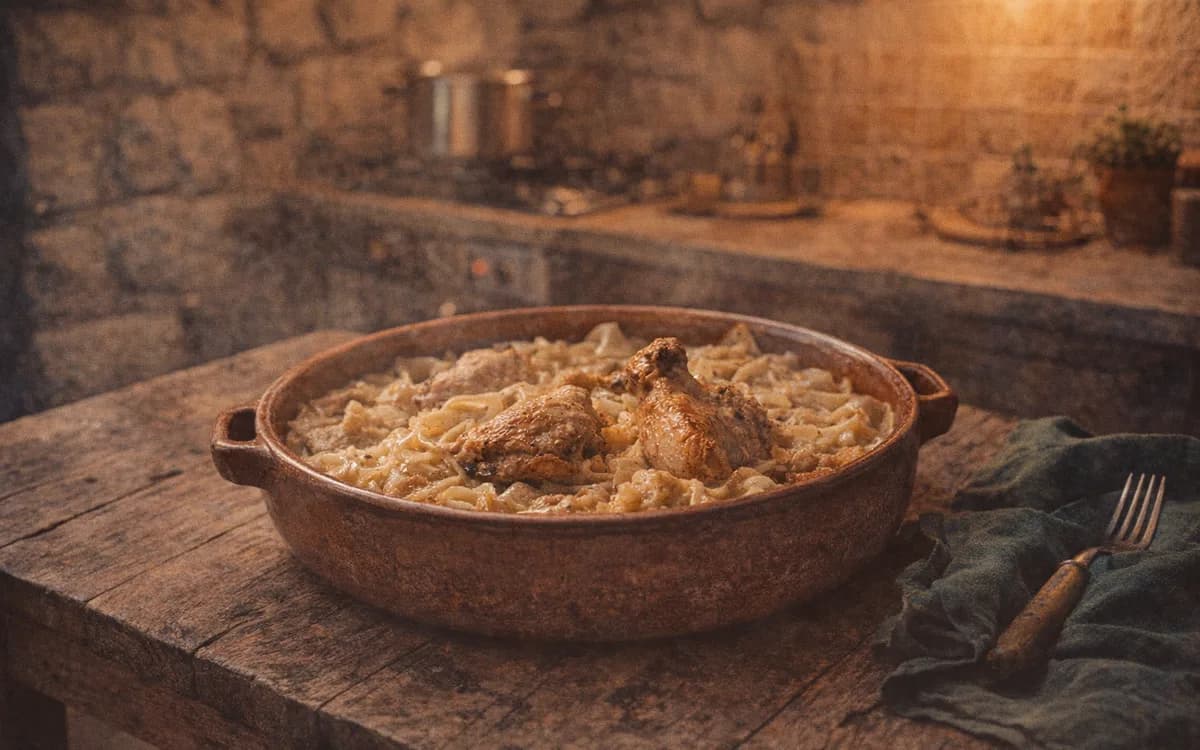
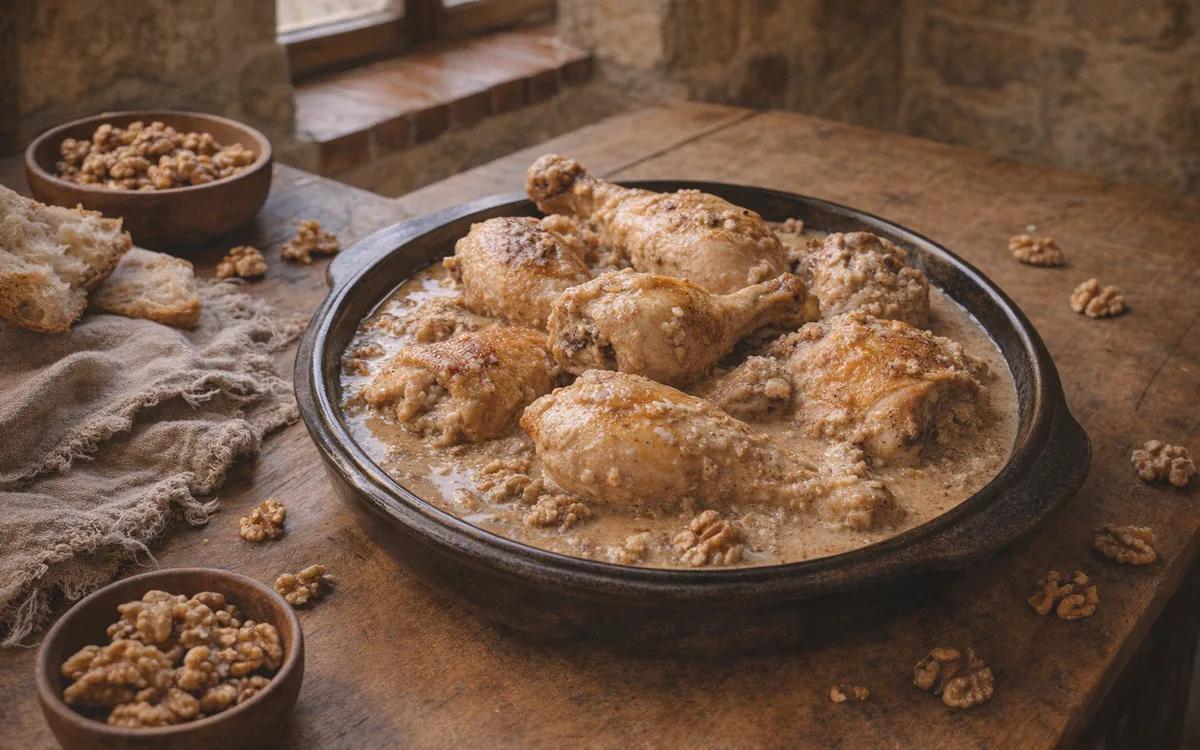
Pule me arra — written pulë me arra in Albanian — means chicken with walnuts. Tender chicken is served with a savoury walnut sauce; in this egg-free preparation, chicken broth, garlic and a little vinegar bring the sauce together, with butter and flour helping it thicken.
We like the contrast in pule me arra: soft chicken, earthy walnuts and just enough acidity to keep each mouthful lively.
The sauce should flow around the chicken, not sit on it like a paste.
Bread is useful at the table.
Household preparations differ. Some include egg yolks; others build their sauce around broth. Here we use one clearly defined method, without eggs, and serve the chicken on the bone. It is not the only way to cook the dish.
Among Albanian autumn recipes, chicken with walnuts suits a cool evening particularly well, although there is no reason to reserve it for one season. Fresh-tasting walnuts matter more than the month. Their flavour carries the sauce, so taste a piece before starting.
Ingredients for Albanian chicken with walnuts
These quantities serve 4 people. Allow approximately 20 minutes of preparation and 65 minutes of cooking, with the chicken’s temperature and the sauce’s texture determining when each stage is ready.
Chicken and poaching liquid
- 1.2 kg bone-in chicken thighs and drumsticks
- About 1.5 litres water, enough to just cover the chicken in a snug saucepan
- 5 g fine salt, plus more to taste after combining
- ¼ teaspoon ground black pepper, plus more to taste
Walnut sauce
- 200 g shelled, unroasted walnuts
- 30 g butter
- 20 g plain wheat flour
- 2 garlic cloves, peeled and crushed
- 10 ml white wine vinegar, added gradually to taste
- 750 ml strained chicken cooking broth, reserved from the pot: use 500 ml initially and keep the remaining 250 ml for adjustments
The water cooks the chicken; the reserved broth makes the sauce. These are not two separate additions of liquid. Use only as much of the reserved 750 ml as needed, depending on evaporation and how finely you grind the walnuts.
Use a lidded saucepan that holds the chicken fairly snugly, a separate saucepan for the sauce, scales, a whisk and a food thermometer. A food processor or mortar will grind the walnuts.
Choosing chicken and walnuts
Bone-in thighs and drumsticks suit gentle simmering and give you both the meat and its cooking broth. Keep to those cuts for this preparation rather than mixing in quick-cooking breast pieces.
Weigh the walnuts without shells. Counts of kernels or halves vary too much to be useful here. They should smell fresh and taste pleasantly nutty, not sharply bitter, stale or paint-like. Rancid nuts will spoil the whole sauce.
This recipe is egg-free, not allergen-free: it contains walnuts, wheat and milk. Check individual ingredient labels when cooking for someone with an allergy.
How to make pulë me arra, step by step
Simmer the chicken and reserve the broth
-
Prepare the chicken and poaching liquid. Do not wash raw chicken. Put the thighs and drumsticks into the lidded saucepan with the 5 g salt and ¼ teaspoon pepper. Add about 1.5 litres of water to just cover them. Bring slowly to a gentle simmer, skimming off foam as it rises. Wash hands and clean utensils and surfaces that have touched raw chicken.
-
Cook gently until done. Partly cover and maintain a quiet simmer, rather than a rolling boil. Start checking after about 35 minutes; larger pieces often need 45 minutes or longer. Insert a food thermometer into the thickest part of each large piece, away from bone. The chicken must reach at least 75°C. Lift the cooked pieces onto a dish and cover while you make the sauce.
-
Strain and measure the broth. Pour the cooking liquid through a fine sieve into a heatproof jug. Reserve 750 ml, keeping it warm: measure out 500 ml for the sauce base and leave 250 ml for loosening. If evaporation has left less than 750 ml, make up the shortfall with hot water. Keep any juices collected beneath the resting chicken.
Build the egg-free walnut sauce
-
Grind the walnuts and crush the garlic. Pulse the 200 g walnuts into a fine, even meal, pausing to scrape down the processor. Stop before they become glossy and clump into nut butter. If using a mortar, work in small batches. Crush the 2 garlic cloves separately so they distribute evenly rather than remaining in sharp little pieces.
-
Cook the butter-and-flour base. Melt the 30 g butter in the separate saucepan over low to medium-low heat. Stir in the 20 g flour and cook for about 2 minutes, stirring continuously, until the raw flour smell fades. Keep it pale. Gradually whisk in the initial 500 ml warm broth, adding a little first to make a smooth paste, then incorporating the rest.
-
Add walnuts, garlic and vinegar. Stir in the ground walnuts and crushed garlic. Cook gently for approximately 8–10 minutes, stirring along the bottom, until cohesive and without a floury taste. Add reserved warm broth in 15 ml increments whenever it becomes too thick. Stir in the vinegar gradually, up to 10 ml, then adjust salt and pepper. At serving temperature, the sauce should coat a spoon and fall from it in a broad ribbon. Fine walnut texture is normal.
Combine, season and serve
- Return the chicken to the sauce. Add the chicken and its collected juices. Turn the pieces carefully to coat them and heat gently for about 5 minutes, or until hot throughout, without vigorous boiling. Check the sauce once more, adding reserved broth in 15 ml increments if needed, and taste again for seasoning. Serve the chicken bone-in, with sauce spooned over and around it.
How to fix thick, grainy or oily chicken walnut sauce
Look at the sauce while it is warm. A cold spoonful will seem much firmer, so judge its consistency at serving temperature. We aim for a loose coating that settles slowly back into the pan after stirring.
- Too thick: Stir in warm reserved broth one tablespoon, or 15 ml, at a time. Let each addition blend in before adding another. Walnuts and cooked flour continue taking up liquid as they stand, so a sauce that looked right ten minutes earlier often needs loosening before serving.
- Too thin: Simmer gently, uncovered, stirring frequently. Give the flour and walnuts time to thicken the liquid before changing anything else. Sprinkling raw flour directly into the finished sauce leaves lumps and an uncooked taste.
- Grainy: A fine, sandy walnut texture is expected. Hard, obvious pieces usually mean the nuts needed more grinding before they entered the pan. Aim for an even meal at that stage, not perfect smoothness in the finished dish. Do not put hot sauce containing chicken bones into a blender.
- Oil collecting on top: Lower the heat and stir in a little warm broth to help bring the sauce together. A badly separated sauce sometimes stays oily despite stirring. Keep subsequent heating gentle.
- Bitter or stale-tasting: Check the nuts before cooking. Extra vinegar or garlic will leave the rancid flavour of spoiled walnuts unchanged.
A little texture is welcome. A stiff mound that holds the shape of the spoon is the signal to add more liquid.
What to serve with pulë me arra
Serve pule me arra with plain rice, bread or simply cooked vegetables to give the walnut sauce somewhere to go. These are serving suggestions, not compulsory traditional accompaniments. Choose one starch rather than crowding the plate; the chicken and sauce are already substantial.
A crisp salad makes a useful contrast. Dress it lightly with vinegar or lemon, or put a small dish of pickled vegetables on the table. Keep that acidic accompaniment separate so everyone can balance their own plate.
For another day’s chicken meal, try jufka, Albanian egg noodles from Dibër homes. Chicken and broth connect the two dishes, but their methods are different, and jufka are not an egg-free alternative. At our kitchen, the published menu includes Pule fshati me jufka — village chicken with jufka noodles. Pulë me arra is not currently listed on that menu.
If walnuts are also calling you towards dessert, a small piece of shëndetlie, Albanian honey-walnut cake is enough after this rich main course.
We enjoy meals that leave room for sharing and conversation. Our Traditional Cooking Class lasts 3–4 hours and includes preparations such as byrek and bread; its dishes vary with the season and group, rather than following this recipe as a fixed lesson. Get in touch to ask which cooking experiences are available for your dates.
Storing and reheating chicken in walnut sauce
Refrigerate leftovers promptly in shallow containers, within two hours of cooking. Keep the refrigerator at 4°C or below and use the chicken and sauce within 48 hours. Divide a large quantity between containers rather than leaving a deep, warm saucepan to cool slowly.
Reheat only the portion you need. Put it in a saucepan with a small splash of water or broth and warm gently, stirring the sauce and turning the chicken carefully. Add liquid gradually as the sauce loosens. Check that the chicken and sauce reach at least 75°C throughout, measuring the meat away from the bone.
For advance preparation, cool and refrigerate the cooked components safely, then combine and reheat thoroughly before serving. Give the chicken time to heat right through while gently turning it in the sauce.
Freezing changes the sauce’s texture, often leaving it grainier or more prone to separation after thawing. Storage time and temperature, rather than smell alone, determine whether cooked chicken is safe to eat.
Frequently asked questions
Does pule me arra contain eggs?
This pule me arra recipe contains no eggs; its sauce uses walnuts, chicken broth and a cooked flour-and-butter base. Other preparations include egg yolks, so the dish name alone does not establish that it is egg-free.
How finely should the walnuts be ground?
Grind the walnuts into a fine, even meal. Stop before they release enough oil to turn into walnut butter; small particles give the finished sauce its characteristic texture.
Is this recipe gluten-free?
No. This version uses wheat flour to help thicken the sauce. An egg-free recipe is not automatically gluten-free, and this preparation also contains walnuts and milk.
Why does walnut sauce become thick after cooling?
Ground walnuts and cooked flour absorb liquid as the sauce rests. Add warm broth a tablespoon at a time during reheating until the sauce coats a spoon and pours easily.
Planning a meal with us in Klos? Book your stay and ask what we’re cooking during your dates.