In this article
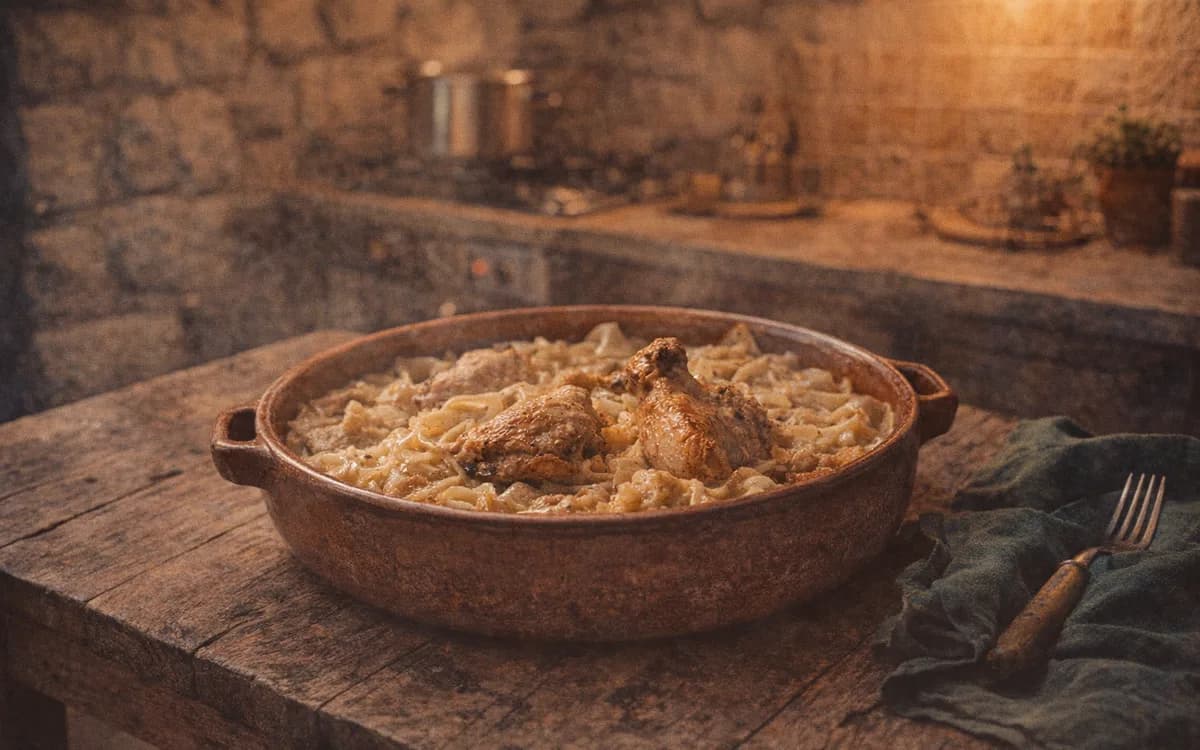
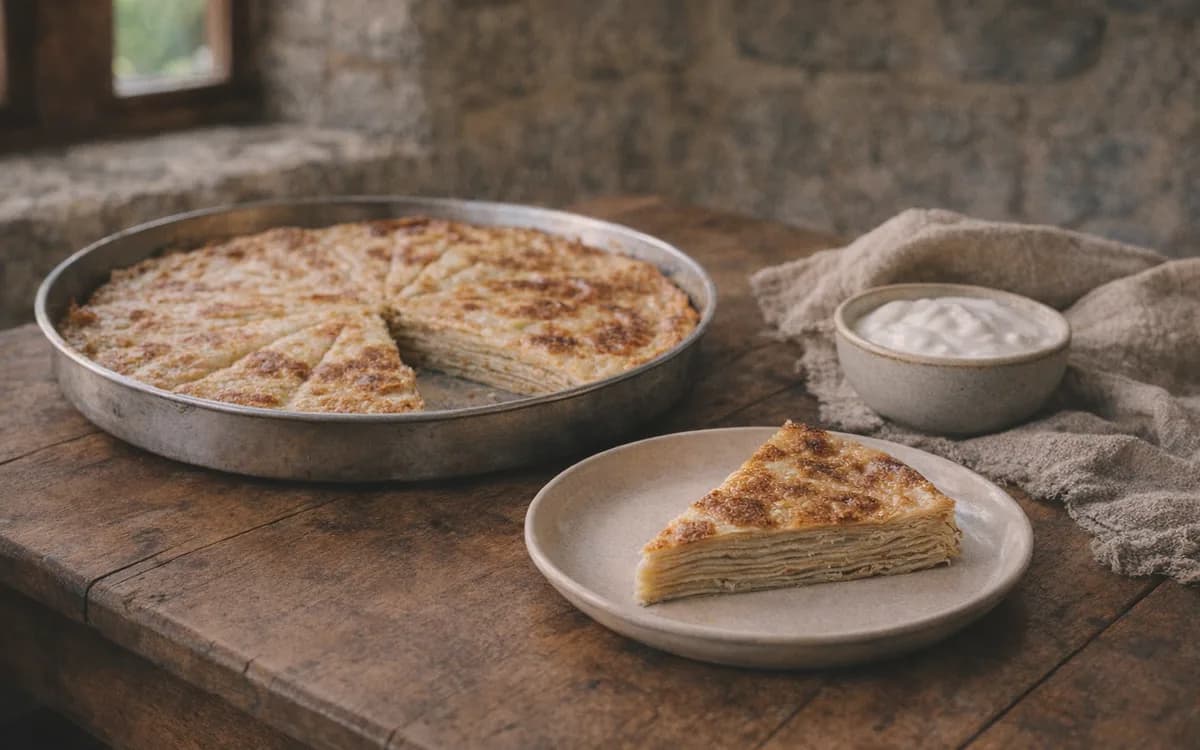
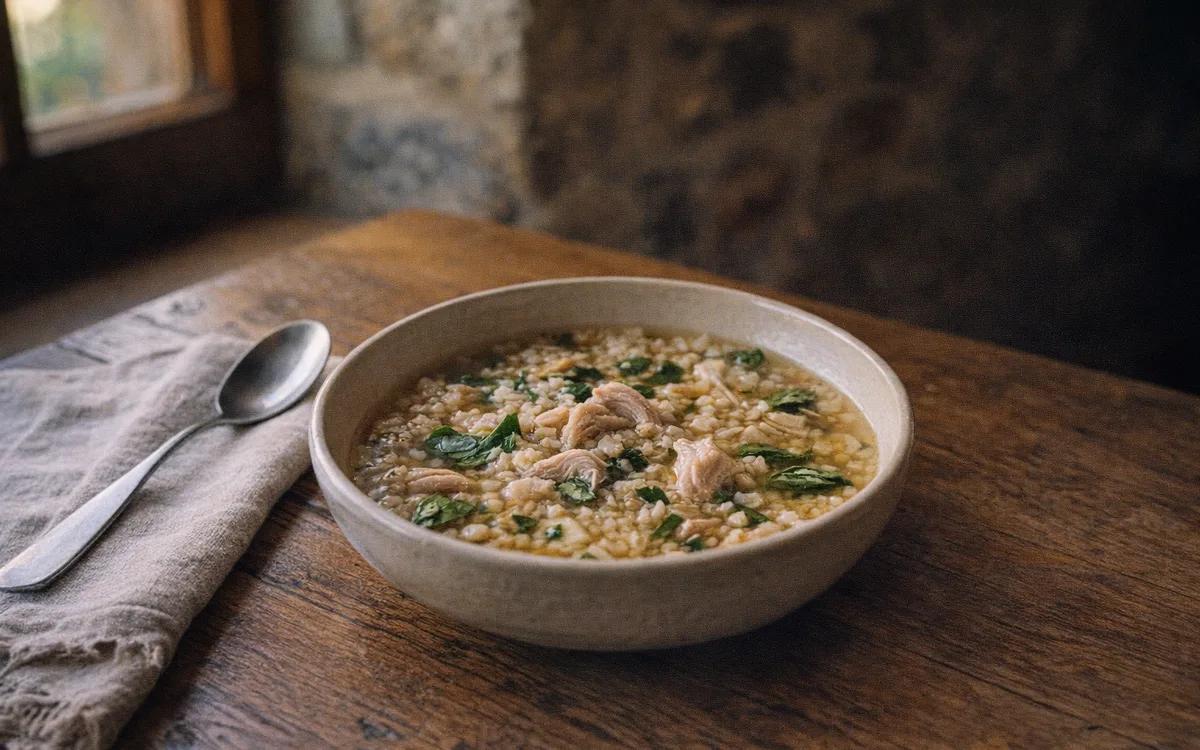
This dromsa recipe begins with flour and little drops of water. Instead of kneading a dough and rolling sheets, we gather the damp flour into small, uneven crumbs, then simmer them in chicken broth until tender. The result is a thick, spoonable supper, with soft chicken and enough broth to carry both through the bowl.
The shaping takes a little patience. Work across a wide tray, wet only a small patch at a time, and resist the urge to gather everything into a dough ball. Those separate crumbs are what we want.
What Are Dromsa? Albanian Pasta Crumbs Explained
Dromësa—small flour-based pasta crumbs—also appear under spellings such as dromsa. You will encounter the name in Cham Albanian cooking and related forms in Arbëresh food traditions in southern Italy. These are distinct communities; a shared pasta name does not mean every household uses the same ingredients or cooking method.
Chicken and basil appear together in a Cham dromësa preparation published by Dritare. Basil gives the chicken version below its finishing aroma, rather than representing a requirement for all dromsa. An Italian discussion of Arbëresh pasta traditions provides another context for the name.
We are sharing a flour-and-water version for home cooking, not presenting dromsa as a Mat Valley specialty or a dish from our restaurant menu.
Dromsa, jufka, and trahana are not the same
Dromsa take shape as separate damp crumbs. Our Dibër jufka recipe follows the different technique of rolling and cutting egg pasta. Jufka give you strands; dromsa give you small, irregular pieces scattered through the broth.
The fermented trahana preparation belongs to another process again. Trahana ingredients and methods vary regionally, but fermentation distinguishes the version discussed there from these freshly formed pasta crumbs. Similar-looking dry pieces need not produce the same flavor or texture.
Dromsa Recipe Ingredients and Equipment
Serves: 4 as a main course
Preparation: approximately 40 minutes
Cooking: approximately 40 minutes
Total: approximately 1 hour 20 minutes
These timings allow for shaping the crumbs before handling the raw chicken. Your first batch may take a little longer.
Ingredients for the crumbs
- 300 g all-purpose flour, approximately 2½ US cups when spooned into the cup and leveled
- 100 ml water to start, plus up to 40 ml more as needed—approximately ⅓ cup plus 1 tablespoon to start, with up to 2 tablespoons plus 2 teaspoons extra
Ingredients for the chicken and broth
- 600 g boneless, skinless chicken thighs, approximately 1⅓ lb, cut into 4 cm pieces
- 2 tablespoons olive oil
- 1 medium onion, finely chopped
- 1.5 liters lightly salted chicken broth, approximately 6⅓ US cups, divided into 1.2 liters for cooking and 300 ml reserved
- ½ teaspoon fine salt, plus more to taste
- ¼ teaspoon ground black pepper
- 10 fresh basil leaves, torn just before adding
You will need a wide tray or shallow bowl, a second tray, a teaspoon, a coarse kitchen sieve, a heavy saucepan with a lid, a small saucepan for reserved broth, and a food thermometer. The sieve should let loose flour fall through while retaining most formed crumbs. A fine tea strainer is too restrictive for this job.
Choose flour and broth for a clear, reliable result
Use ordinary all-purpose wheat flour for this version. Coarse semolina absorbs water differently, while stronger bread flour can change the bite; neither is a straight substitution here. Weigh the flour if possible, because a packed cup holds considerably more than a lightly filled one.
Lightly salted broth leaves room for adjustment as the dish thickens. The recipe contains wheat, but no added egg or dairy; check purchased broth for additional allergens.
How to Make Homemade Crumb Pasta from Scratch
Sprinkle, form, and separate the crumbs
-
Spread the flour. Put the 300 g flour in a wide tray in a shallow, even layer. Measure 100 ml water into a small jug and keep the additional 40 ml separate. Set a clean second tray beside you for the finished crumbs.
-
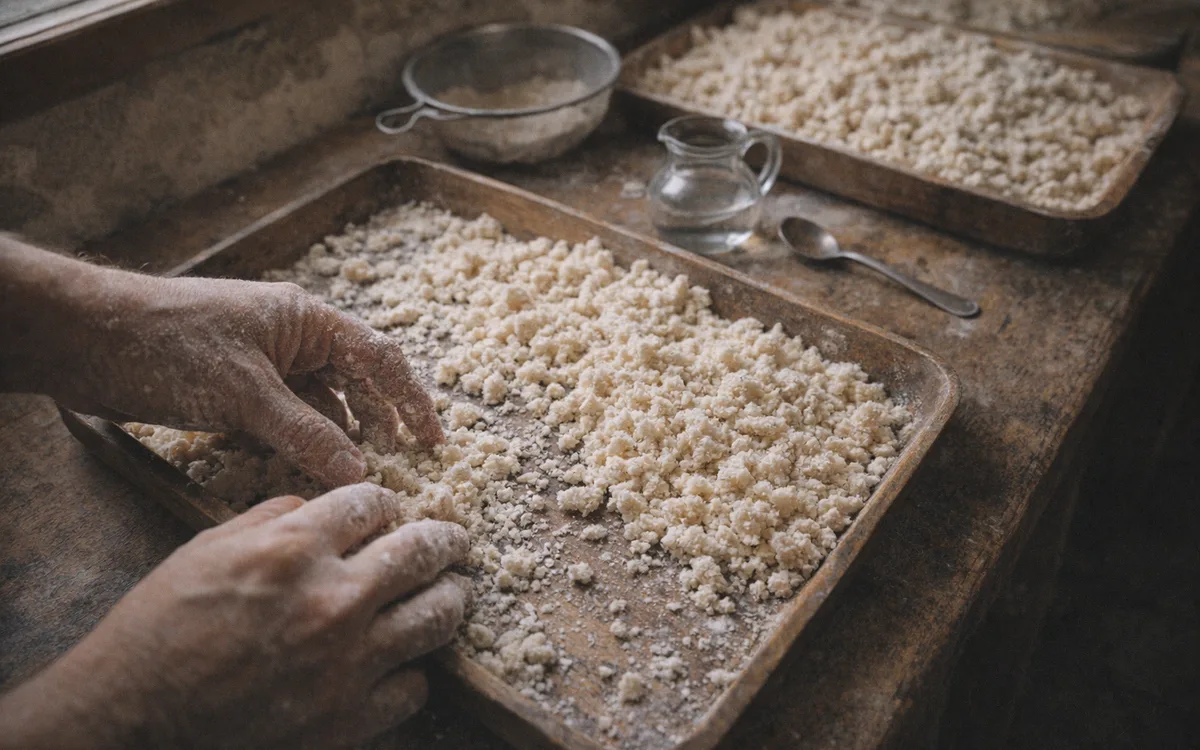
Wet a small patch. Drip a teaspoon or two of water across one patch of flour, scattering the droplets rather than pouring a puddle. Move your fingertips lightly through that patch, tossing and rubbing the damp specks against dry flour. Stop before the mixture gathers into a single mass.
-
Separate and repeat. Aim for irregular crumbs roughly 2–5 mm across, with no wet coating on your fingers. Lift a portion into the coarse sieve and shake gently over the flour tray. Transfer retained crumbs to the clean tray. Break larger soft clumps with your fingers, then repeat the sprinkling and sifting with the remaining flour. Use the extra water a teaspoon at a time only if needed; do not pour it in simply to empty the jug.
-
Rest and test a few crumbs. Spread the crumbs loosely while you prepare the pan. They should feel separate and lightly firm on the outside, not sticky. Bring 100 ml of the reserved chicken broth to a gentle simmer in the small saucepan and add a teaspoon of crumbs. Begin checking after 5 minutes, continuing until they have no raw, chalky center. Keep the test broth and crumbs to return to the main pot later.
The small size range is a useful working target, not a demand for identical beads. Some pieces will be rounder, others ragged. Very large pieces are the ones to break apart, because they can remain floury inside after their smaller neighbors have softened.
Check the texture before cooking the whole batch
The test portion should hold together during a gentle simmer. Bite through a cooled crumb: it should be tender throughout, with a little substance rather than a dusty center.
If dry flour falls away from the uncooked batch, sieve it again before cooking. Loose flour carried into the broth thickens it immediately and can hide whether the actual pasta is done.
This brief rest is only for surface firming. It does not make the pasta shelf-stable, and there is no need to wait for the crumbs to become completely hard before cooking.
How to Cook Dromsa with Chicken
Build the broth and cook the chicken safely
-
Prepare the chicken separately. Once the crumbs are formed, cut the chicken into 4 cm pieces on a separate board. Wash your hands and clean the knife, board, and work surface afterward. Keep the pasta tray away from raw-chicken utensils and splashes.
-
Soften the onion. Heat the 2 tablespoons olive oil in the heavy saucepan over medium heat. Add the chopped onion and cook for 6–8 minutes, stirring, until softened but not deeply browned. Add the chicken, ½ teaspoon salt, and ¼ teaspoon pepper. Turn the pieces through the onion and oil for about 2 minutes.
-
Simmer and remove the chicken. Pour in 1.2 liters chicken broth. Bring just to a boil, lower the heat, and partially cover. Simmer for approximately 15–20 minutes, until the chicken reaches 74°C/165°F in its thickest part. Lift it onto a clean plate and cover. Now taste the broth and adjust the salt if needed.
Removing the chicken gives the crumbs time to finish without keeping the meat over the heat throughout. Thigh pieces are forgiving, but a hard boil still makes them tighten and sends the broth splashing unnecessarily.
Add the crumbs and finish at the right consistency
-
Simmer the pasta gently. Return the test broth and its cooked crumbs to the main saucepan. Scatter in the remaining crumbs gradually, stirring gently as they fall so they do not settle in one mound. Maintain a quiet simmer, with the lid off. Cook for approximately 8–15 minutes, stirring along the bottom occasionally. Begin tasting early; the crumbs must be tender without a raw flour center.
-
Adjust the broth. Heat the remaining 200 ml reserved broth in the small saucepan. Add it to the main pot in small pours whenever the mixture becomes thick before the crumbs are tender. The finished dish should be loose enough to spoon into bowls, not dry like a pilaf. You may not need every drop.
-
Return the chicken and finish. Add the chicken and any juices from its plate. Heat through until the chicken reaches 74°C/165°F again. Fold in the 10 torn basil leaves, taste for salt, and serve promptly.
The cooking range is a starting point. Crumb size and how firmly the flour gathered affect the time, so let the cooled bite from your spoon settle the question. A little broth between the pieces is welcome: the pasta continues absorbing liquid even after the pan leaves the stove.
Fix Sticky Crumbs and Store Leftovers Safely
Why the crumbs clump or the broth turns pasty
Large, wet clumps during shaping: you have wetted too much flour at once. Stop adding water, break the clumps into the surrounding dry flour, and return to scattered droplets. Do not knead them into a dough ball.
A dusty tray of crumbs: sift away the loose flour before cooking. It belongs in the shaping tray, not in the saucepan. Prolonged boiling cannot undo a broth overwhelmed by excess flour.
Crumbs sticking to the bottom: lower the heat and move a spoon gently across the base. If the pot is becoming dry, add hot reserved broth. Vigorous stirring can break the softening pieces without solving the heat problem.
A dish that thickens on standing: loosen it with hot broth and serve. Next time, finish slightly looser than you want it in the bowl.
Cook fresh crumbs promptly. To keep uncooked crumbs for another day, freeze them spread in a single layer, then transfer the frozen pieces to a sealed container. Do not treat a short air-drying rest as preservation for cupboard storage.
For cooked chicken leftovers, refrigerate within two hours, using shallow containers, and keep at 4°C/40°F or below. Use within three to four days. Reheat with added broth as needed until the food reaches 74°C/165°F throughout.
Expect softer pasta the next day. The crumbs keep absorbing broth in storage, so reheating restores warmth and looseness rather than the exact texture of the first serving.
Serving Dromsa for an Autumn Supper
We would put something sharp beside this bowl: a plain green salad or a small plate of pickled vegetables. Their acidity gives a useful contrast to the soft pasta and chicken. Neither pairing is compulsory.
For a meat-free adaptation, omit the chicken, use vegetable broth, and cook sliced mushrooms with the onion. That is a variation, not a claim about one fixed traditional recipe. Check the broth ingredients before calling it vegetarian.
If these small pasta shapes lead you toward more Albanian cooking, our kitchen offers a different introduction in Klos. Pule fshati me jufka is our village chicken with jufka noodles; Byrek Bujtine is our house-style byrek, and Tavë dheu is a traditional clay-pot dish. Dromsa are not listed on our menu. The recipe here is something to make at home, with time to work the flour between your fingers.
Frequently asked questions
Are dromsa and trahana the same thing?
No. Dromsa are small pasta crumbs formed from moistened flour. Fermented trahana is a different preparation, although trahana ingredients and methods vary by region.
Does dromsa need a pasta machine?
No. The crumbs are formed by sprinkling water onto flour and working it lightly by hand. You do not roll or cut pasta sheets.
Can dromsa be made without chicken?
Yes. Use vegetable broth and mushrooms for a meat-free adaptation. Check the broth and any other additions before calling the finished dish vegetarian.
Why does dromsa become thick after cooking?
The pasta crumbs continue absorbing liquid as the dish stands. Add hot broth a little at a time to loosen the mixture for serving or reheating.
Planning a visit to Klos and curious about Albanian cooking? Get in touch—we’ll help you plan a meal around your visit.