In this article
- What are Albanian cabbage rolls?
- Beef-and-rice dollma recipe: ingredients and quantities
- How to soften cabbage leaves without tearing them
- How to roll and pack Albanian stuffed cabbage
- How long to simmer cabbage rolls with rice and beef
- What to serve with dollma, and how to store leftovers
- Frequently asked questions
Albanian cabbage rolls begin with a simple test: can the leaf fold around the filling without splitting? Get that right, leave room for the rice to swell, and the rest is a quiet, covered simmer. Here we make dollma me lakër (stuffed cabbage) with fresh white cabbage, minced beef, rice, onion, and parsley.
What are Albanian cabbage rolls?
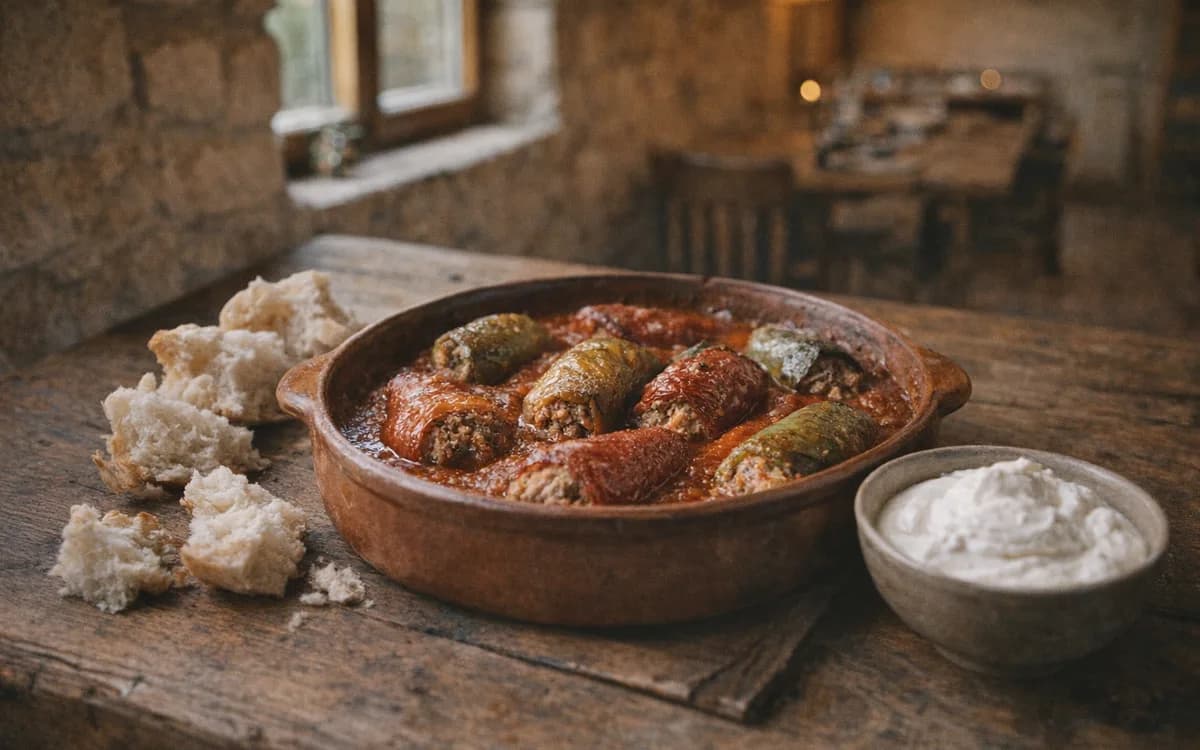
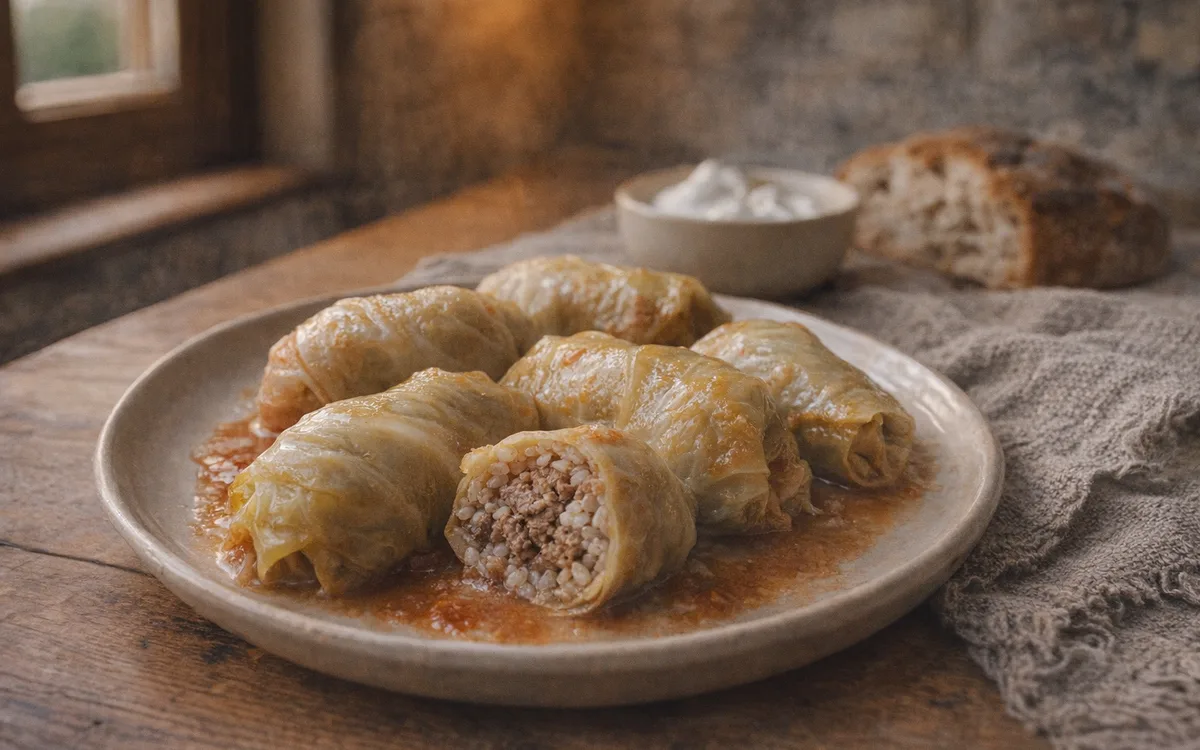
These are individual parcels of softened cabbage wrapped around a raw beef-and-rice filling, then cooked together in a covered pot. The leaves become tender, the rice absorbs the cooking liquid, and a little tomato paste gives the juices colour and depth.
This is one home-style version, not a rule for every Albanian household. Seasonings and cooking liquids vary, as do the names used for stuffed leaves. You may also see the name written as dollma me laker, without the Albanian ë.
Unlike a loose cabbage stew, the leaves here stay whole around their filling. We use fresh cabbage, not fermented cabbage; the latter brings its own acidity and salt and needs different preparation.
At our kitchen, our menu includes Byrek Bujtine (house-style byrek) and Pule fshati me jufka (village chicken with noodles), while our wood-fired oven is used for breads, pies, and slow dishes. These cabbage rolls are a recipe for your own hob, not a claim that dollma is on our restaurant menu.
Beef-and-rice dollma recipe: ingredients and quantities
Makes approximately 18–22 medium rolls, serving 4–6. The number depends on the usable leaves and how much filling each can comfortably hold.
Allow 45–60 minutes for preparation, 75–90 minutes of gentle simmering once the pot reaches a simmer, and 10–15 minutes of resting. Firm cabbage or larger parcels may need longer; use the doneness checks below rather than the clock alone.
Ingredients
- 1 fresh white cabbage, approximately 1.5–2 kg
- 500 g minced beef, preferably with moderate fat rather than very lean
- 120 g uncooked long-grain white rice
- 1 onion, approximately 150 g, finely chopped
- 30 ml olive oil, divided: 15 ml for the onion and 15 ml for the cooking liquid
- 20 g fresh parsley, chopped
- 30 g tomato paste
- 8 g fine salt, divided: 6 g for the filling and 2 g for the cooking liquid; reduce the latter if using salted stock
- 1/2 teaspoon ground black pepper
- 700–900 ml hot water or low-salt stock to start, plus hot water as needed during cooking
You will need a large blanching pot, tongs, a sharp knife, a stable chopping board, and a heavy, lidded casserole approximately 24–26 cm wide. A broad serving spoon and a food thermometer are useful too.
Which cabbage and rice work best?
Choose a cabbage with broad, undamaged leaves. A head with several badly split outer leaves will give fewer wrappers. Savoy cabbage is a softer alternative, but its leaves may become tender sooner, so cooking time will differ.
Use ordinary long-grain white rice for this version. Brown rice, instant rice, and already cooked rice do not behave the same way. Keep the tomato paste and parsley as the baseline; dried mint, paprika, or lemon are optional household variations, not requirements.
Mix the filling without making it dense
- Heat 15 ml olive oil in a frying pan. Soften the chopped onion over medium-low heat until translucent, without browning it. Spread it on a plate and let it cool before adding it to raw beef.
- Rinse the rice and drain it well. Combine it uncooked with the beef, cooled onion, parsley, 6 g salt, and black pepper.
- Mix lightly with a fork or your fingertips, just until evenly combined. Do not knead it into a paste. Refrigerate the filling while you prepare the leaves, and never taste it raw.
How to soften cabbage leaves without tearing them
The aim is a flexible wrapper, not fully cooked cabbage. A ready leaf drapes over your hand instead of standing stiffly away from it.
- Remove damaged outer leaves. Set the cabbage securely on a chopping board and carefully cut around the core with a sharp knife, removing the hard central plug without dividing the head into wedges.
- Lower the cabbage carefully into a large pot of gently boiling water. Allow the exposed outer leaves to soften, then ease them away individually with tongs. Do not pull hard against a leaf that still grips the head.
- Allow roughly 2–4 minutes for each exposed outer leaf, checking its flexibility rather than timing the whole cabbage as one piece. Remove each leaf when it bends readily around its rib; return the head to the water as needed to release the next layer.
- Drain the leaves and let them cool enough to handle. Lay each one flat and shave down the raised rib with the knife held nearly parallel to the leaf. Take thin slices off the ridge without cutting a hole through the centre.
- Prepare approximately 18–22 wrapping pieces. Especially large leaves can be divided beside the thick central rib; save smaller or torn leaves for lining the casserole.
Run a fingertip gently along the trimmed rib. It should feel flatter, with no hard ridge that would force the parcel open. If a leaf still cracks when folded, give it another brief dip in the hot water before trimming or rolling.
How to roll and pack Albanian stuffed cabbage
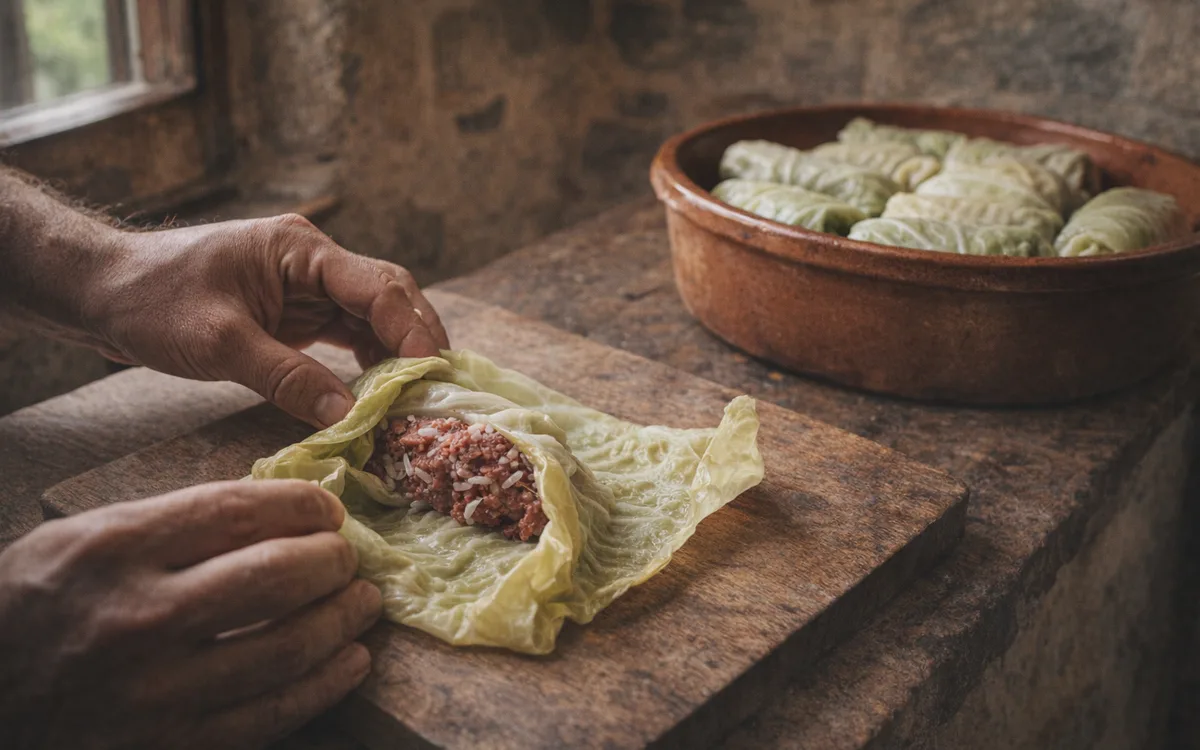
Keep the filling portions modest. There is uncooked rice inside, and it needs space to expand without bursting the wrapper.
- Lay a cooled leaf on the board with the trimmed rib side facing up and the stem end nearest you.
- Place approximately two level tablespoons of filling near the stem end. Use less for a smaller leaf, leaving clear margins on both sides.
- Fold the base of the leaf over the filling, then fold both sides inward.
- Roll towards the tip, enclosing the filling without pulling the cabbage taut. The finished parcel should hold its shape when lifted but should not feel stretched tight.
- Line the casserole base with reserved cabbage pieces. Arrange the rolls seam-side down, close together without crushing them, in one or two even layers.
A small tear can be covered with a second piece of leaf before rolling. If the tear runs across most of the wrapper, use that leaf for the pot lining instead. A patch should help the parcel close, not create a thick bundle of cabbage around a tiny filling.
For another wrapper, our japrak recipe uses vine leaves. Those smaller leaves need their own preparation; do not treat them as interchangeable with fresh cabbage.
Why cabbage rolls split or unravel
Stiff ribs, insufficient blanching, and too much filling cause splitting. Upward-facing seams, large gaps between parcels, and a rolling boil encourage unraveling.
Pack the pot closely, not the filling tightly. Neighbouring rolls support each other, while a little give inside each parcel lets the rice swell.
How long to simmer cabbage rolls with rice and beef
Whisk the tomato paste, remaining 15 ml olive oil, and remaining 2 g salt into the hot water or stock. Reduce or omit that last portion of salt if the stock is already seasoned.
Pour the liquid slowly around the rolls until it comes just below the top of the uppermost layer. Start with the stated 700–900 ml range, but let the level take precedence: a wide pot and a deeper, two-layer arrangement will not need identical amounts. Do not completely submerge the upper rolls.
Bring to a gentle simmer, cover, and turn the heat low. Cook for approximately 75–90 minutes, checking earlier if the parcels are small. You want occasional quiet bubbles, not leaves bouncing in boiling liquid.
Do not stir. Check periodically and pour small amounts of hot water around the edge if the liquid is running low. The lining protects the base, but it cannot prevent scorching in a dry pot.
Check a representative large roll, including one from the upper layer. All three signs must be present:
- Tender cabbage: a knife cuts through the wrapper easily.
- Cooked rice: the grains are soft throughout, without a firm, chalky centre.
- Safe beef temperature: the centre of the filling reaches at least 75°C.
Meat can reach a safe temperature before the rice is tender. Check both.
What to do if the rice is still hard
Add a small splash of hot water if needed, cover, and continue cooking gently in 10–15-minute increments. Insufficient moisture, oversized parcels, or densely packed filling can slow the rice down. Higher heat is not the answer; it risks scorching the bottom and splitting the leaves.
When done, rest the pot covered, off the heat, for 10–15 minutes. Lift the rolls with a broad spoon. If the juices are too thin, transfer some to a separate saucepan and reduce them there rather than boiling the finished parcels hard.
What to serve with dollma, and how to store leftovers
We would put plain yogurt, bread, and something sharp alongside the pot. A crisp salad works well, as do the vegetables in our Albanian turshi guide. The beef and rice already make these rolls a main course; another starch is optional, not necessary.
A meat-free filling needs its own balance of rice, vegetables, fat, and liquid. Simply replacing 500 g beef with the same weight of rice would make a very different recipe and overcrowd the leaves.
Serving the rolls without breaking them
Give them their resting time. Slide a broad spoon underneath each parcel and lift rather than drag it across its neighbours. Spoon a little cooking liquid over each serving and keep the yogurt separate so everyone can add their own.
For advance preparation, cook the rolls first and cool them safely rather than leaving raw beef-and-rice parcels waiting for an unspecified time.
Cooling, freezing, and reheating safely
Divide leftovers into shallow containers and cool promptly, ideally within one hour. Refrigerate at 5°C or below and eat within 24 hours. Do not leave the whole heavy casserole cooling slowly on the counter.
For longer storage, freeze promptly cooled cooked rolls in meal-sized portions with some sauce. Use within two months for best quality, and thaw in the refrigerator.
Reheat only once, covered with a little liquid, until steaming throughout and at least 75°C at the centre. Heat only the portions you plan to eat instead of repeatedly warming the entire batch.
Rice safety depends on prompt cooling and cold storage. Reheating cannot reliably undo unsafe storage, and smell alone does not tell you whether rice is safe to eat.
Frequently asked questions
Does the rice need cooking before it goes into dollma?
No. This recipe uses rinsed, uncooked long-grain white rice, which absorbs liquid during the covered simmer. Leave expansion room inside each roll and check that the grains are tender before serving.
Is fresh cabbage or fermented cabbage used for Albanian cabbage rolls?
This version uses fresh cabbage softened in boiling water. Fermented cabbage appears in other household versions, but it changes the salt, acidity, and leaf preparation; it is not a straight swap here.
Why do cabbage rolls split while cooking?
Common causes are under-softened leaves, thick untrimmed ribs, excessive filling, and vigorous boiling. Flexible leaves, modest portions, seam-side-down packing, and a gentle simmer help keep the parcels intact.
Can cooked beef-and-rice dollma be frozen?
Yes. Cool promptly, freeze in meal-sized portions with a little sauce, and use within two months for best quality. Thaw in the refrigerator and reheat once until the centre reaches at least 75°C.
Want to practise Albanian home cooking with us? Our Traditional Cooking Class lasts 3–4 hours and ends with the meal you have made. Ask about a cooking class during your visit; dishes vary with the season and group.