In this article
- What is pastiçe, Albania’s baked spaghetti dish?
- Ingredients and pan size for pastiçe with feta
- Pastice recipe: how to make Albanian baked pasta
- Why is pastice watery, dry or difficult to slice?
- Simple substitutions without changing the whole recipe
- What to serve with pastice and how to store leftovers
- Frequently asked questions
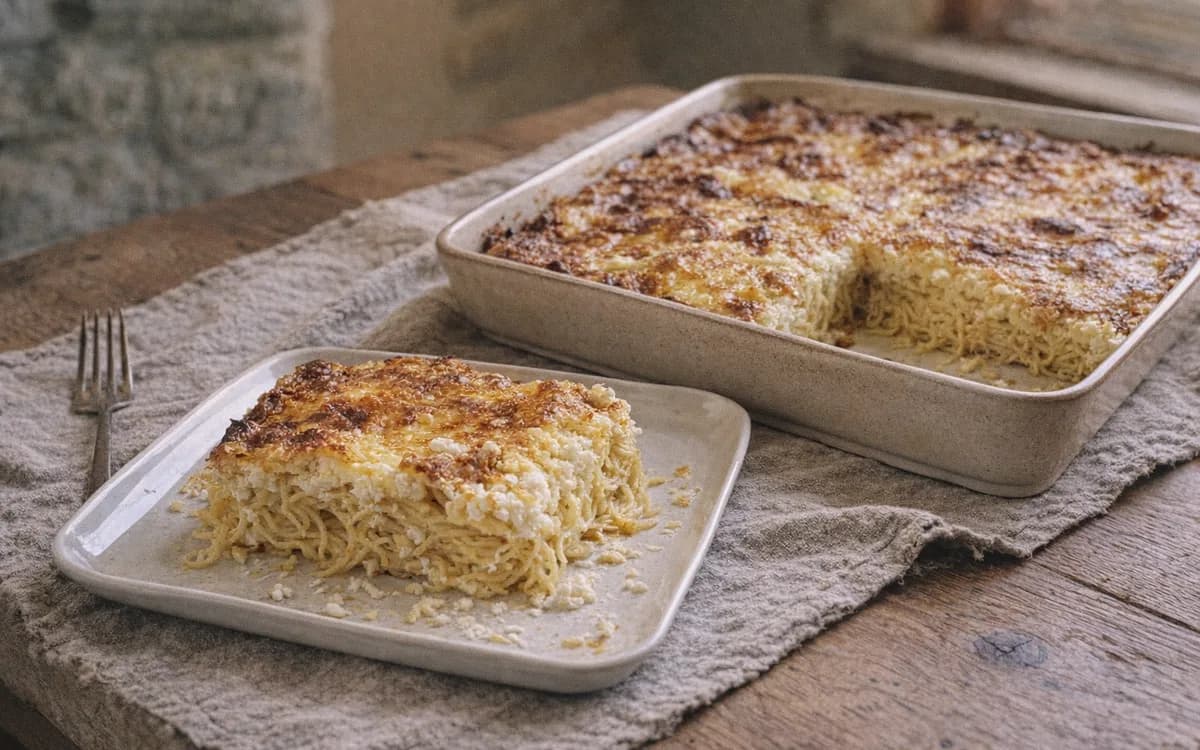
This pastice recipe brings spaghetti, feta, eggs and milk together beneath a golden crust. Inside, the pasta stays tender, held by a soft egg-and-milk custard rather than a thick sauce. There is no meat and no béchamel. We like it with something sharp alongside and a little patience before cutting: those few minutes of resting help each portion hold together.
What is pastiçe, Albania’s baked spaghetti dish?
Pastiçe—baked pasta—is an Albanian home-style dish commonly made with spaghetti, eggs, milk and white brined cheese. Families change the proportions, the cheese and sometimes the topping. This is one straightforward version, not a claim that every Albanian household makes it the same way.
If you know Greek pastitsio as a layered dish with meat sauce and béchamel, expect something different here. Our version has neither layer. The milk and eggs flow between the spaghetti strands, then set around them in the oven. Feta brings small salty pockets throughout, while the exposed strands become pleasantly crisp.
The result is substantial enough for a family supper without a meat accompaniment. Cut it into generous portions and let the contrast between the browned surface and tender middle do the work.
At our kitchen, the menu includes Byrek Bujtine (our house-style byrek pie) and Tavë dheu (a traditional clay-pot dish). Pastiçe is not a listed menu dish; this is an Albanian home-cooking recipe to make in your own kitchen.
Ingredients and pan size for pastiçe with feta
Makes: about 6 main-course portions.
Baking dish: approximately 30 × 22 cm, at least 6 cm deep. Use an oven-safe dish with enough room above the assembled pasta to prevent spills.
Ingredients
- 400 g dry spaghetti
- 800 ml whole milk
- 4 large eggs
- 250 g drained feta, crumbled; reserve 50 g for the top
- 30 g butter; use 10 g for greasing and 20 g for topping
- ¼ teaspoon ground black pepper
- Salt, optional, for the pasta water and custard, according to the cheese’s saltiness
The useful ratio is 200 ml milk, 1 large egg and roughly 60–65 g feta for every 100 g dry spaghetti. The milk is not acting alone: eggs set the custard, and the cheese contributes body as well as flavour.
Measure the milk rather than pouring by eye. Before baking, the mixture looks surprisingly wet, but adding extra pasta to absorb that liquid can leave the finished bake dry. Equally, extra milk can make the centre slow to set.
The pan matters too. A much wider dish spreads everything thinly and exposes more pasta to the oven; a smaller, deeper one takes longer to cook through. Keep close to the stated dimensions for the baking window below.
Which cheese and pasta work best?
Choose drained block feta or a comparable firm white brined cheese. Crumble it unevenly, leaving a few small pieces rather than turning it into a paste. Those pieces give the finished slices some character.
Gjizë, a fresh curd cheese, differs in moisture, salt and texture, so it is not a direct replacement here. Our Albanian cheese guide explains the differences between these cheeses without complicating your shopping list.
Use ordinary dried spaghetti for this recipe. Short pasta packs differently, while fresh pasta needs different handling. If you would like to make pasta from scratch another day, our jufka recipe introduces Albanian egg noodles; you do not need handmade jufka for this casserole.
Pastice recipe: how to make Albanian baked pasta
Allow 25 minutes for preparation, including boiling the spaghetti; 40–50 minutes for baking; and 15–20 minutes for resting. Total time is approximately 80–95 minutes. Have the dish, a large mixing bowl and a colander ready before you begin.
Use 180°C conventional or 160°C fan throughout. Pan material, the depth of the assembled bake and the accuracy of your oven can shift the timing, so judge the centre as well as the crust.
Boil the spaghetti just short of done
-
Heat the oven to 180°C conventional or 160°C fan, with a shelf in the middle. Grease the base and sides of the baking dish with 10 g of the measured butter. Bring a large saucepan of water to the boil; add salt lightly, if using, because the feta will provide much of the seasoning.
-
Cook the 400 g spaghetti for about 2 minutes less than the packet’s stated al dente time. It should bend easily but still offer a firm bite. Drain thoroughly, shaking the colander to release trapped water, then spread the spaghetti in the prepared baking dish. Leave it for about 5 minutes while you mix the custard, until it has lost its fierce heat.
Do not leave the spaghetti sitting in its cooking water. It will continue softening, and water carried into the dish will dilute the measured custard. There is no need to rinse it.
Mix the eggs, milk and feta
-
Taste a small piece of feta on its own to judge its saltiness. In a large bowl, whisk the 4 eggs with the 800 ml milk until evenly combined, with no obvious streaks of egg white. Stir in the pepper and 200 g of the crumbled feta. Add a small pinch of salt only if the cheese needs it; do not taste the mixture after adding raw eggs.
-
Pour the custard over the warm spaghetti. Gently lift and settle the strands with two forks so the cheese and liquid reach throughout the dish. Level the surface without pressing it tightly. Scatter over the reserved 50 g feta and dot with the remaining 20 g butter, cut into small pieces.
Expect visible milk between the strands. You are assembling wet pasta in a thin custard, not coating it in a creamy sauce. Leave the measured proportions as they are.
Bake until set, then rest before slicing
-
Bake on the middle shelf for 40–50 minutes. Begin checking at 40 minutes: the surface should be golden and the centre should no longer look liquid when the dish is nudged gently. Check that the centre reaches at least 74°C with a food thermometer, keeping the probe away from the dish itself.
-
If the top is brown before the centre is cooked, cover loosely with foil and continue baking at the same temperature until the centre is set and reaches 74°C. The colour of the crust alone is not a doneness test.
-
Remove from the oven and rest for 15–20 minutes before cutting into 6 portions. Use a sharp knife to cut through the top, then lift each portion with a broad spatula.
Resting lets the cooked custard firm up slightly. It cannot finish cooking an underdone centre, so make the temperature check before taking the dish out.
Why is pastice watery, dry or difficult to slice?
A warm custard-bound bake stays tender. It need not stand in rigid squares to be successful, but liquid pooling in the centre needs attention.
A watery centre or loose slices
Visible liquid in the middle: insufficient baking is one possible cause, especially in a deeper dish. Return it to the oven, protect the top loosely with foil and cook until the centre is set and reaches 74°C.
Poorly drained pasta, unusually wet cheese or extra milk can also upset the balance. For the next batch, drain both pasta and feta well and measure the dairy. Do not sprinkle raw flour into the assembled casserole as a rescue; it can leave floury pockets rather than an even custard.
Cooked through but falling apart: give it the full resting period. Cutting straight from the oven releases steam and custard before the portions have had time to settle. A broad spatula helps support the strands as you lift them.
Dry pasta, tough edges or a dark top
A few crisp strands on the surface are welcome. Dryness throughout usually points to too little milk, prolonged baking or a dish that spreads the mixture too thinly.
Use the stated pan size and start checking at the beginning of the baking window. Once the middle is cooked, do not keep baking just to chase a darker crust. An oven running hot can brown the edges early; foil protects the surface while the centre finishes.
Simple substitutions without changing the whole recipe
Household versions vary, but we would keep the first batch close to these quantities. Once you know the texture, you have a useful reference for later changes.
A firm white brined cheese with moisture and texture similar to feta is the simplest substitution. Drain it well, use the same weight and judge its saltiness before mixing the custard. A very soft or spreadable cheese will not behave in the same way.
Lactose-free dairy milk is the closest substitute for ordinary whole milk. It does not make a casserole containing feta dairy-free, so check all ingredients if you are cooking for someone with a dietary restriction.
For a strictly vegetarian meal, choose cheese made with vegetarian rennet. Being meatless does not automatically mean every feta is suitable for vegetarians.
We would not remove the eggs from this method: they provide the structure that holds the pasta together. Plant milk alone cannot replace that binding function. Added vegetables, meat or a béchamel topping also need their own instructions, because they change moisture, depth and cooking time. Keep this version simple rather than adding several changes at once.
What to serve with pastice and how to store leftovers
We favour a sharp green salad alongside the rich pasta. Sliced tomatoes are lovely in season; in colder months, a small serving of pickled vegetables gives the same welcome contrast. A lemony or vinegary dressing is enough. There is no need for bread, potatoes or another starch.
Serve the first portions after resting, while the centre is still warm and tender. Later slices become firmer, which makes leftovers easy to portion for lunch.
Refrigerating and reheating
Refrigerate leftovers within 2 hours of baking. Divide them into shallow containers and cover for storage rather than leaving the whole casserole on the counter until completely cold.
Keep at 4°C or colder and eat within 3–4 days. Reheat individual portions covered until the centre reaches 74°C. A small splash of milk around a portion helps prevent drying; it is a reheating aid, not a change to the original recipe quantities.
In the oven, a covered oven-safe dish at 180°C conventional or 160°C fan works well. Timing depends on portion size and starting temperature, so use the centre temperature rather than a fixed number of minutes. If microwaving, use a microwave-safe cover and check more than one spot for cold patches.
Freezing and making ahead
For longer storage, cool safely, divide into portions, wrap well and freeze promptly. Use within 2–3 months for best quality, then thaw in the refrigerator before reheating. Freezing can make the custard slightly grainier, though the portions remain useful for an easy meal.
For next-day supper, bake the casserole ahead, refrigerate it promptly and reheat covered. That is simpler than holding warm spaghetti in raw custard while waiting to bake.
Frequently asked questions
Does Albanian pastice need béchamel?
No. This version uses eggs and milk to bind the spaghetti and feta as it bakes, with no flour or separate white sauce. Other household versions use different toppings.
Does the spaghetti need boiling before baking?
Yes, the spaghetti must be boiled first for this recipe. Cook it about 2 minutes short of the packet’s al dente time so it can finish in the oven without becoming overly soft.
How long should pastice rest before slicing?
Rest it for 15–20 minutes after baking. This helps the fully cooked egg-and-milk mixture firm up, giving you neater portions without losing the tender centre.
Can pastice be made the day before?
Yes. Bake it, refrigerate in shallow covered containers within 2 hours, then reheat covered the next day until the centre reaches 74°C.
For more Albanian cooking together, explore our cooking class, a 3–4-hour hands-on session followed by the meal you make. Ask which dishes we will be preparing during your visit to Klos; the lesson varies with the season and group.