In this article
- What is kulaç, and how is this yogurt version different?
- Ingredients for Albanian yogurt bread: choosing the right yogurt
- Kulac recipe: mix and shape the dough without overworking it
- Baking Albanian soda bread: loaf depth and doneness checks
- Why is kulaç dense, gummy or bitter?
- What to serve with kulaç, and how to keep leftovers
- Frequently asked questions
What is kulaç, and how is this yogurt version different?
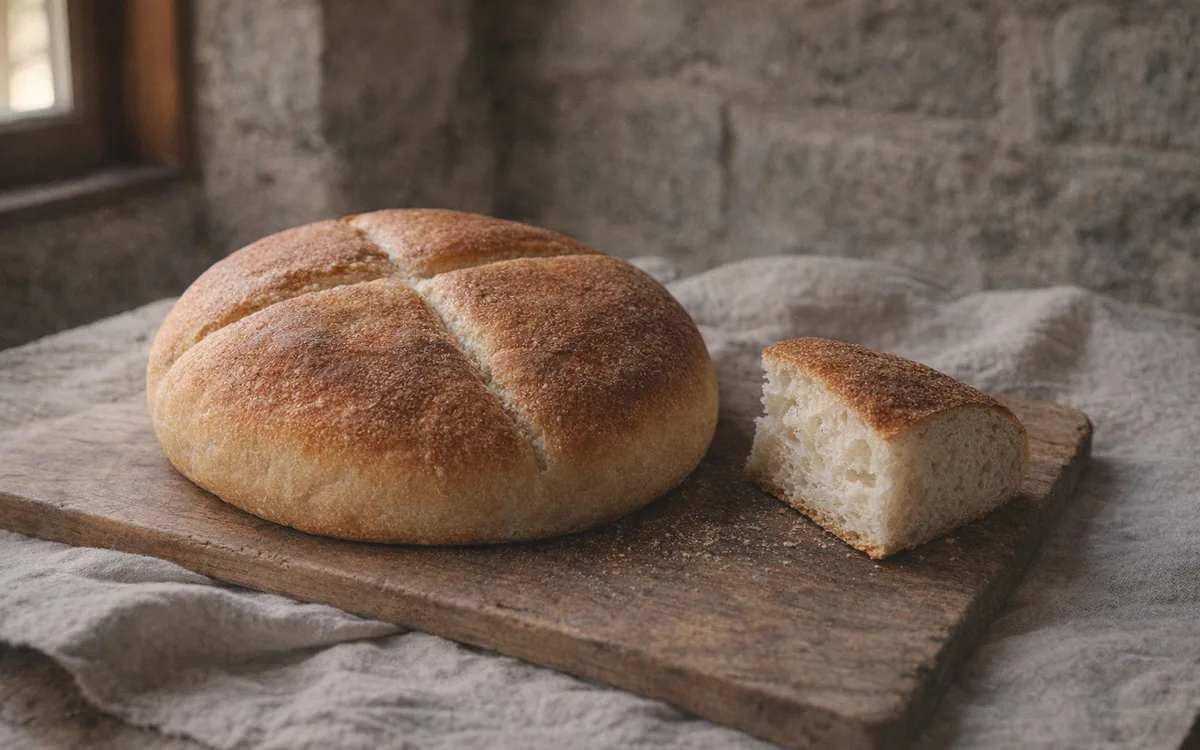
Our kulac recipe makes a round of Albanian yogurt bread without yeast or a long rise. The useful details are in the dough: the thickness of the yogurt, a light hand when mixing and a loaf shallow enough to bake through before its crust gets too dark.
Kulaç is an Albanian round bread with variations from household to household. Here we are making kulaç me kos (kulaç with yogurt), using plain wheat flour and baking soda. Yogurt supplies the acidity that reacts with the soda; there is no proving stage and no reason to knead it like a yeast loaf.
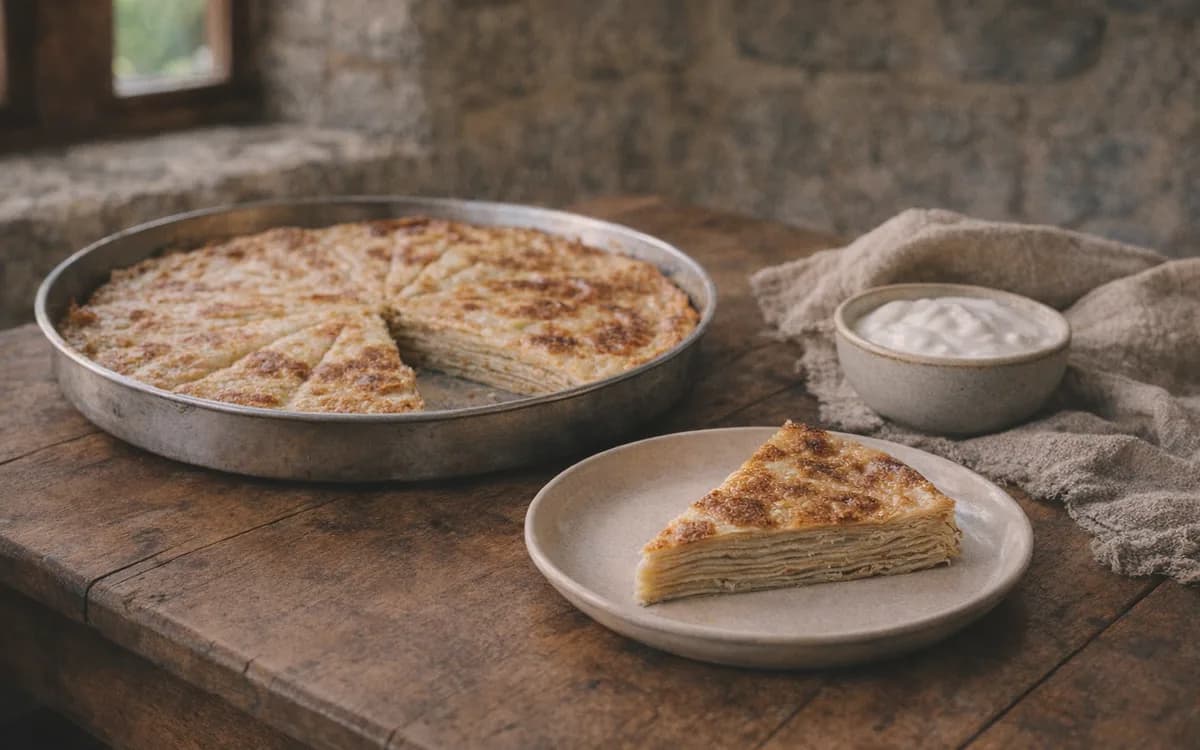
Expect a close, tender crumb beneath a browned crust. This is bread for cutting into sturdy wedges, not a loaf with large, airy holes. We like that texture beside white cheese or a bowl of stew, where the bread can catch a little broth without falling apart.
This version is a standalone loaf. It is not the only way to make kulaç, and it does not need to become part of another dish to earn its place at lunch.
Ingredients for Albanian yogurt bread: choosing the right yogurt
Makes: 1 round loaf, about 8 wedges
Preparation: 15 minutes
Baking: 35–45 minutes; allow longer if the centre needs it
Cooling: at least 40 minutes
Total allowance: about 1 hour 40 minutes, including cooling
You will need kitchen scales, a large bowl, a fork or sturdy spoon, baking parchment, a wire rack and a shallow 24 cm round metal tin. The dough itself will be shaped to approximately 22 cm across.
Ingredients
- 500 g plain wheat flour, also called all-purpose flour
- 425 g plain, unsweetened full-fat yogurt, spoonable but easily stirred
- 5 g baking soda, also called bicarbonate of soda
- 8 g fine salt
- Up to 30 g water, reserved for adjustment and added only if needed
- Up to 10 g extra plain flour, reserved for lightly dusting your hands and work surface
Use plain flour rather than self-raising flour. Baking soda is not baking powder: they behave differently, so do not exchange them spoon for spoon. Weigh the soda on scales that can measure small quantities accurately.
The yogurt should slide from a spoon in a thick ribbon when stirred. Avoid sweetened or flavoured varieties. Full-fat yogurt makes a useful starting point, but its thickness alone cannot tell you how acidic it is or how much liquid your particular flour will absorb.
Runny yogurt versus thick or Greek-style yogurt
For very runny yogurt, begin with 400 g of the measured 425 g, keeping the remaining 25 g beside the bowl. Add that remainder only if dry flour remains after mixing.
For thick, strained yogurt, replace the 425 g regular yogurt with 375 g plain Greek-style yogurt mixed with 50 g water. That gives 425 g of loosened yogurt; the separate 30 g adjustment water remains available if necessary. These are starting proportions, not a promise that every brand behaves alike. Let the dough-feel cues below decide whether it needs another small splash.
Kulac recipe: mix and shape the dough without overworking it
Have everything ready before the yogurt meets the flour. Once wet and dry ingredients combine, the soda reaction begins; a slow shaping session or a wait for the oven wastes some of that early lift.
Method
- Heat the oven and prepare the tin. Preheat to 200°C conventional / 180°C fan, with a rack in the middle. Line the base of a shallow 24 cm round metal tin with baking parchment. Measure all the ingredients before beginning to mix.
- Combine the dry ingredients. Put 500 g plain flour, 5 g baking soda and 8 g fine salt in a large bowl. Whisk thoroughly, reaching the bottom and edges, so the soda is evenly distributed.
- Add the yogurt. Add 425 g regular yogurt and stir with a fork or sturdy spoon, scraping loose flour into the damp dough. If your yogurt is notably runny, start with 400 g and hold back 25 g. If using strained yogurt, first mix 375 g Greek-style yogurt with 50 g water and use that mixture instead.
- Adjust and bring together. If the dough has dry, crumbly pockets, add any held-back yogurt first, then the reserved adjustment water in 5 g additions, using no more than 30 g water. Fold and press gently just until the flour is incorporated. The dough should be soft, slightly tacky and able to hold a rough round.
- Shape a shallow round. Lightly dust your hands and work surface, using no more than the reserved 10 g flour. Turn out the dough, gather it with a few gentle folds and transfer it to the tin. Pat it to approximately 22 cm across and 2.5–3 cm thick. Cut a shallow cross, about 5 mm deep, over the top with a sharp knife.
- Bake promptly. Put the tin straight into the oven. Bake for 35–45 minutes, beginning your checks at 35 minutes. Look for a well-browned crust and a set centre; a skewer inserted into the middle should emerge without wet dough. If the surface darkens before the middle is baked, tent loosely with foil and continue baking until the centre is done.
- Cool before cutting. Leave the loaf in its tin for 5 minutes, then lift it onto a wire rack. Cool for at least another 35 minutes, giving it at least 40 minutes altogether before slicing. If the centre still feels very hot, wait longer before cutting wedges.
The dough-feel check before shaping
A little dough should cling to your fingers. That is different from a wet mixture that spreads across the worktop. Correctly hydrated dough gathers into one soft mass when pressed, even if its surface looks rough.
Dry dough cracks apart and leaves flour in the bowl. Add the measured liquid gradually rather than forcing those crumbs together. If the dough feels sticky, first scrape it together with a spoon and use lightly floured hands; repeatedly burying it in flour makes a heavy loaf. Note the yogurt and water you actually used, so your next batch starts closer to the right consistency.
Baking Albanian soda bread: loaf depth and doneness checks
The shape matters as much as the clock. With this quantity of dough, a shallow round gives the heat a shorter path to the centre than a tall, compact ball.
Use the 24 cm tin as a support, not as a mould that must be filled to the rim. The dough starts approximately 22 cm wide, with a little room around it. A smaller tin that forces the same dough upwards changes the bake: the crust can colour while the middle is still sticky.
Shallow round versus a deeper loaf
- A wider, shallow round exposes more dough to the oven's heat and generally bakes through sooner. Start checking at the early end of the timing range.
- A narrower, thicker loaf takes longer for its centre to set. Simply waiting for a dark crust is not enough to judge it.
- A deeper empty tin does not automatically mean deeper bread. Look at the dough's actual thickness; the pan material and how closely its sides surround the loaf also affect browning.
Check more than one sign of doneness. The crust should have good colour, the centre should feel set rather than soft beneath the surface, and a skewer should come out without sticky raw dough. A hollow sound when you tap the base can support those checks, but it cannot replace them.
If the top gets ahead of the middle, cover it loosely with foil and carry on baking. There is no fixed number of extra minutes that suits every oven.
Then give the loaf its cooling time. Steam continues to move through the crumb after baking, and cutting too soon compresses the soft centre. The rack keeps the underside from sitting in trapped moisture. Slightly warm wedges are lovely; a steaming-hot cut can make a properly baked loaf seem gummy.
Why is kulaç dense, gummy or bitter?
Dense and dry: A close crumb is normal for this bread, but it should not crumble into dry rubble. Too much flour, too little liquid or prolonged handling can make it heavy. Next time, weigh the dusting flour, stop mixing sooner and check for a soft dough before shaping.
Gummy in the middle: Think about loaf thickness, baking and cooling before adding more flour to the next batch. A tall round may need longer in the oven; a hot loaf may simply need more time on the rack. Check the centre rather than judging by the outer crust alone.
Bitter or soapy: Too much soda, or soda left in concentrated patches, can spoil the flavour. Weigh the 5 g carefully and whisk it thoroughly through the flour. Extra soda is not a shortcut to a lighter loaf.
Dark outside, wet inside: Check that you used the correct conventional or fan setting, placed the rack centrally and shaped a shallow round. Protect an already browned top with foil while the centre finishes. A thicker loaf is not rescued by browning its surface harder.
Very little lift: Make sure the ingredient was bicarbonate of soda, that it is within its usable life and that the oven was fully hot before mixing. Do not leave the finished dough waiting on the counter for a rise: this no yeast Albanian bread goes directly from shaping to baking.
What to serve with kulaç, and how to keep leftovers
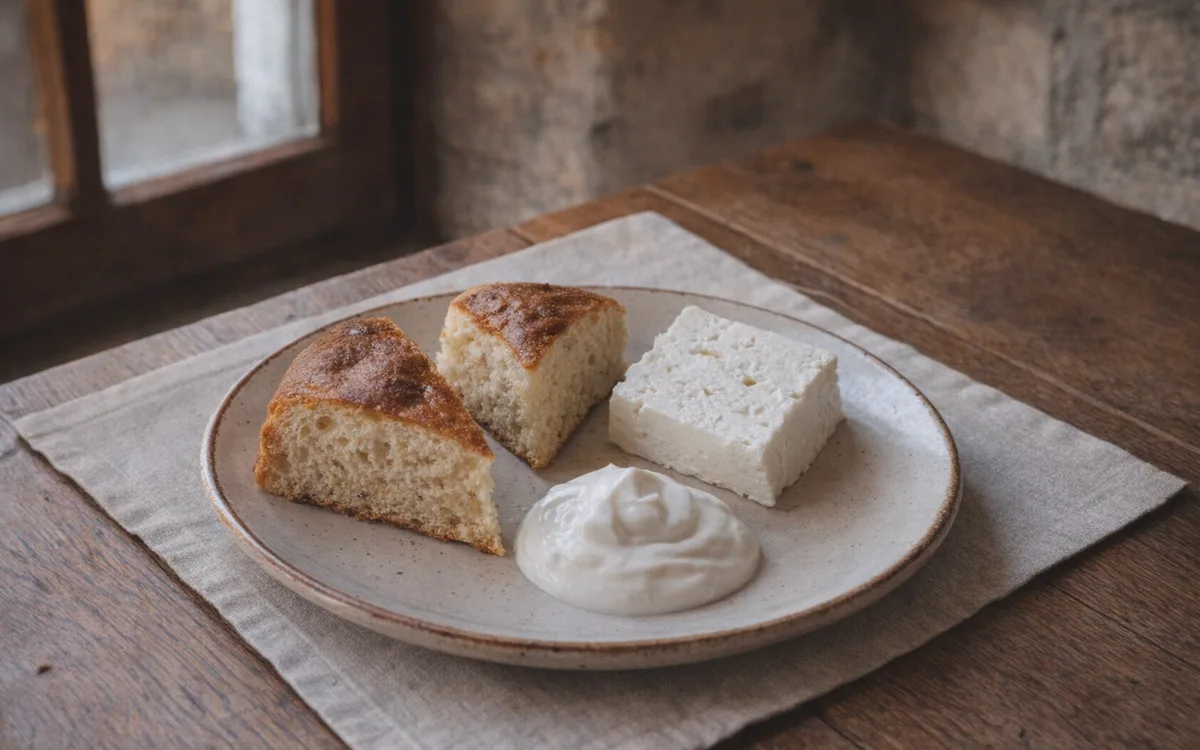
For breakfast, put a wedge beside white brined cheese and a spoonful of plain yogurt. The mild bread takes well to a salty cheese without needing butter as well. Our Albanian cheese guide explains the differences between white cheese, gjizë and kaçkavall if you are choosing at a shop counter.
For a cold-day lunch, serve thicker wedges with jani me fasule, Albanian bean stew. Keep some crust intact for dipping, and let the beans and their broth do the rest.
At Bujtina Çupa, our menu includes Djathë dele (sheep cheese) and Djathë dhie (goat cheese). Bread and pies also have a place in our kitchen, where we use a wood-fired oven and serve Byrek Bujtine (our house-style byrek). This kulaç bakes in an ordinary home oven.
The loaf is best on the day it is baked. Once completely cool, wrap it and keep it in a cool, dry place for about one to two days. For longer storage, freeze individual wedges or slices in a well-sealed container.
Toast leftover slices, or warm wedges gently in the oven until heated through. Reheating softens bread that has begun to stale, but it does not make spoiled bread safe. Discard a mouldy loaf rather than cutting away the visible patch.
Frequently asked questions
Does kulaç need yeast or time to rise?
This yogurt-and-baking-soda kulaç needs neither yeast nor proofing. Put it into a fully preheated oven promptly after mixing and shaping; do not wait for the dough to rise on the counter.
Can Greek yogurt be used for kulaç me kos?
Yes. For this loaf, start with 375 g plain Greek-style yogurt loosened with 50 g water instead of the 425 g regular yogurt. Use the separate adjustment water only if needed to make a soft, slightly tacky dough.
Why is kulaç still gummy in the middle?
A gummy centre can come from an underbaked or overly thick loaf, or from slicing before the crumb has set. Check the dough depth, test the centre for wet dough and allow at least 40 minutes of cooling before cutting.
Can kulaç dough be mixed the night before?
Bake the mixed dough promptly because baking soda starts reacting with yogurt immediately. You can measure the dry ingredients and yogurt separately the night before, keeping the yogurt refrigerated until you are ready to bake.
Want to explore Albanian bread-making with us? Find out about a cooking class, then book your stay and ask what we’re preparing during your visit.